
Leaving Diskit
We leave the white terraces of Diskit Monastery beneath a sky already beginning to close. From the west, clouds advance in long gray battalions over the barren folds of the mountains, deliberate and soundless, swallowing the pale blue of the afternoon. The prayer flags above the monastery flutter wildly for a moment, then fall still again, as if listening.
Our vehicle descends toward the openness near Khalsar, and soon the road runs like a dark thread through the pale sands.
Wind skims over the dunes in faint shifting veils. Nothing grows except sparse thorn and occasional patches of brittle grass clinging to the distant riverbanks of Shyok. Yet there is no emptiness in it. The silence has texture; it presses upon the skin.
At Khalsar crossing we turn eastward, following the course of the Shyok River. According to the Yarakandi (Ladakh) origins Shyok originates from “Sheo” meaning “river of death”, possibly due to its treacherous nature when the water increases. Howeber Tibetan origins names it as Shayog: “shag” means gravel, “gyog” means spread, due to the vast amounts of gravel it deposits. However in this hour it appears strangely gentle, braided streams of silver moving through an ocean of gravel. Again and again the road approaches the water and withdraws from it, as though uncertain of the river’s moods. The Shyok does not carve the valley so much as haunt it. One senses that in flood season it can erase roads, memory, even certainty itself.
Beyond the dunes of Khalsar the valley widened into something almost lunar — a vast pale basin strewn with gravel and ash-colored stone, hemmed in by mountains whose slopes seemed flayed open to their geological bones.
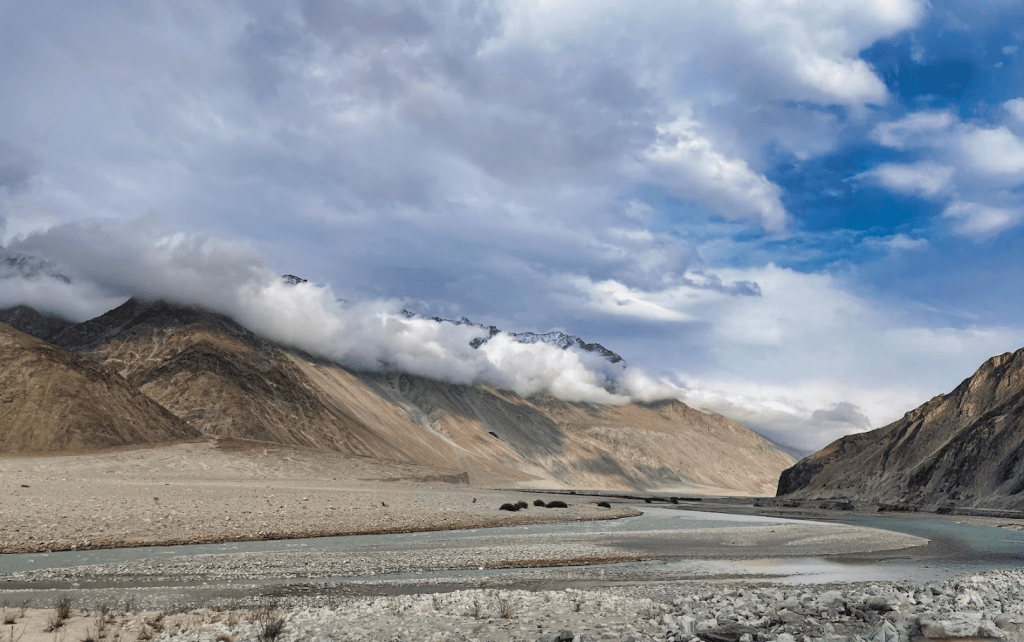
Clouds gathered low upon the mountainsides, not drifting above them but clinging to them, pouring through the ridges like smoke from unseen fires. At times the peaks vanished entirely, and only the lower buttresses remained visible — immense and solemn beneath the moving weather. The mountains of Ladakh do not rise with the exuberance of greener ranges; they appear exhausted, ancient beyond reckoning, worn down by cold and silence into pure form.
Road of Gravels and Stones
Somewhere between the inhabited clusters before Durbuk, the road dissolved altogether.
The driver turned off the main track without ceremony and guided the vehicle down onto the immense stony bed of the Shyok River. There was no proper road here — only faint tire marks wandering through an ocean of rounded stones, as though other travellers too had crossed this wilderness uncertainly, leaving behind temporary suggestions rather than paths. The wind was howling outside followed by the sullen clouds. The car moved slowly over the stones, its tires crunching through the dry riverbed with a sound that seemed unnaturally loud in that vast silence. There was something primitive about this crossing. No villages. No prayer walls. No electric poles. Only rock, weather, and the uncertain thread of human passage. At moments the valley broadened into such immensity that scale itself disappeared. The mountains across the Shyok became dark silhouettes behind curtains of wind, and between them lay miles of pale gravel flats strewn with glacial stones. Small thorn bushes bent under the wind, their roots clinging stubbornly to this desolation. The earth here seemed unfinished, still in the process of becoming.
And yet the feeling was not hostile. Rather, one sensed an indifference so complete that it became strangely peaceful. The mountains neither welcomed nor threatened us. They merely existed — immense, weathered presences older than memory or ambition. In such places the mind begins to loosen its grip upon ordinary concerns. The future narrows to immediate things: the movement of clouds through a pass, the texture of rain that was beginning to form upon the windshield, the uncertain course ahead across the stone flats.
We drove on through that dim weather for some time – the mountains remained half-hidden behind curtains of cloud, immense shadowy forms watching silently from beyond the riverbed. Then, beyond a scatter of thorn bushes bent by the wind, the gray ribbon of asphalt re-emerged from the wilderness — sudden and almost improbable — winding eastward once more beside the Shyok River, leading us deeper into the cold and solitary heart of Ladakh.
The farther we travelled along the Shyok, the more the world appeared stripped to essentials — rock, water, wind, sky. And perhaps for that reason the mind also began to empty itself of its usual noise. One no longer thought very much about destinations.
Norboo, who had taken the wheel by then, pointed toward the dark mass of cloud gathering somewhere beyond Chang La and said quietly that the storm had settled over the pass. Those coming from Leh toward Pangong Tso would likely be stranded there for some time. He spoke without drama, merely stating a fact of mountain weather — how swiftly these high roads surrender to cloud, snow, or falling stone. Later that evening, upon reaching Pangong, we would learn that many vehicles had indeed been halted near the upper reaches of the pass and had to turn back.
Sign of Life
Farther along the valley, where even the scattered willows had vanished and the world had returned once more to stone, wind, and silence, we came upon a small procession of wild creatures upon the road.
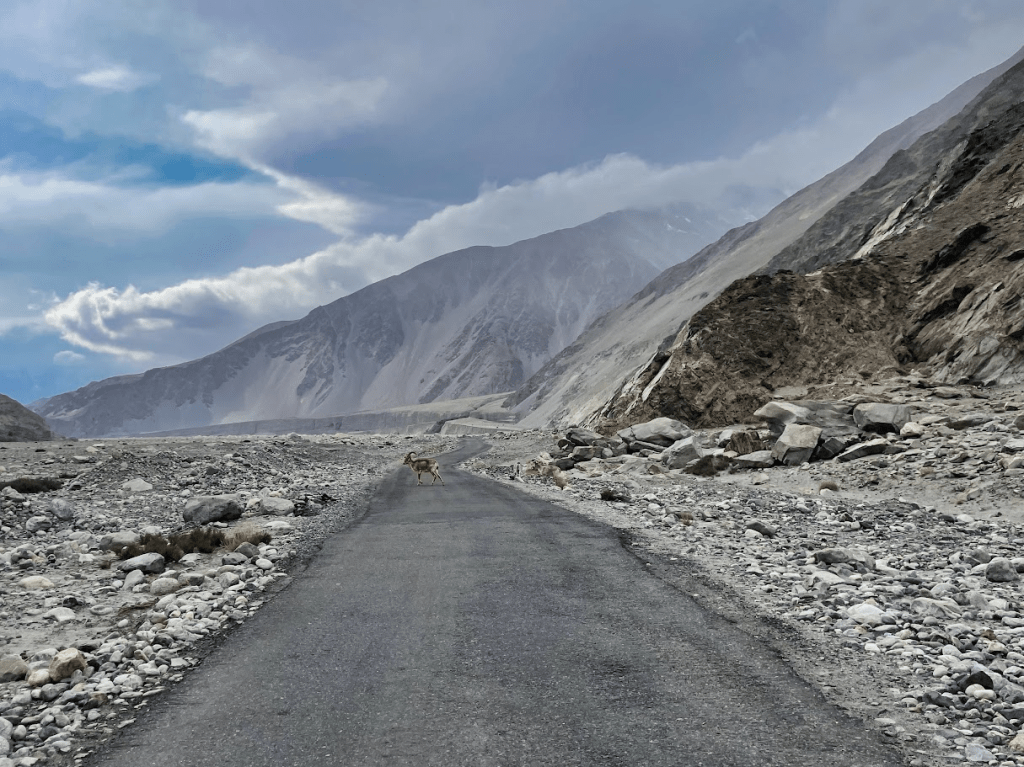
At first there was only one — standing motionless on the dark ribbon of asphalt ahead of us, delicate and alert against the immense desolation surrounding it. Its reddish coat glowed softly in the muted evening light, blending almost perfectly with the barren slopes behind. The animal’s curved horns and wary posture made me think at first of an Asiatic ibex, but Norboo slowed the vehicle and said quietly that it was an urial — the red sheep of these cold trans-Himalayan valleys.
The urial is among the hardiest inhabitants of Ladakh, a wild mountain sheep adapted to survive in landscapes where almost nothing seems capable of living. They graze upon sparse tufts of alpine grass scattered among stone and scree, moving across these exposed valleys with a caution born from centuries of predators and winter storms. Somewhere beyond the ridges above us, hidden among the cliffs and snowfields, the snow leopard still follows their ancient paths. The lone urial crossed the road slowly, without panic, placing each step carefully upon the wet asphalt. Then from the barren slope behind it emerged three more, smaller and lighter in color, following the first in quiet succession across the empty highway.
We remained still and watched them pass.
Behind the animals rose immense mountains stripped bare to their mineral bones — gray, ash-colored, and scarred by old landslides. Storm clouds drifted low upon the ridges, while occasional shafts of sunlight broke through and illuminated distant slopes with a strange cold radiance.
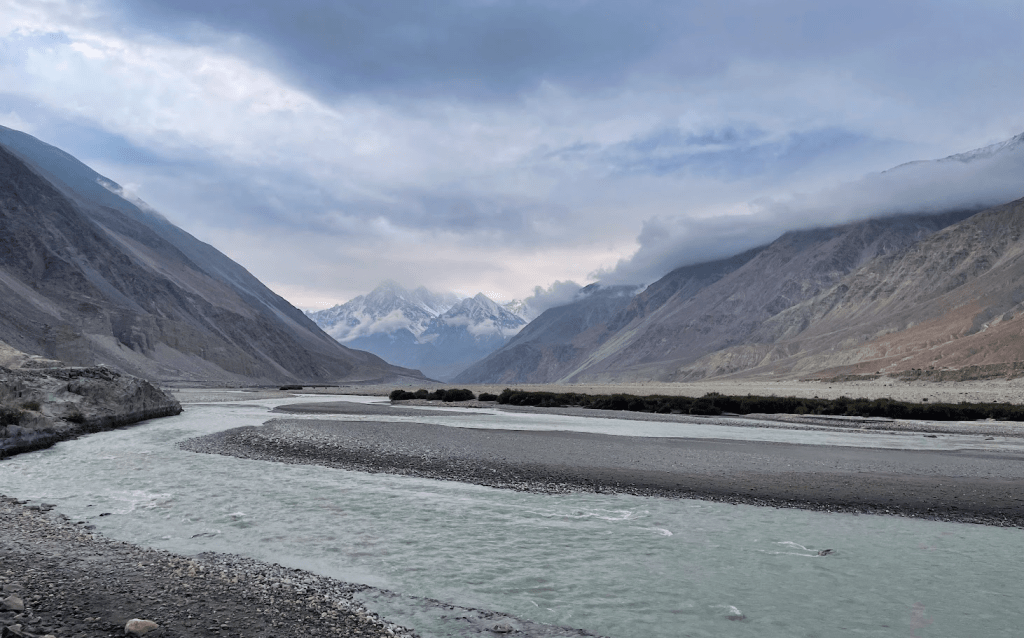
But the mountains alter their moods suddenly. An hour later, beyond a bend where the valley narrowed between dark cliffs, the sky opened on the farther side of the range as though some invisible curtain had been drawn aside. Sunlight spilled quietly across the valley floor. The storm clouds haven’t chased us here, and the world emerged washed and luminous beneath them.
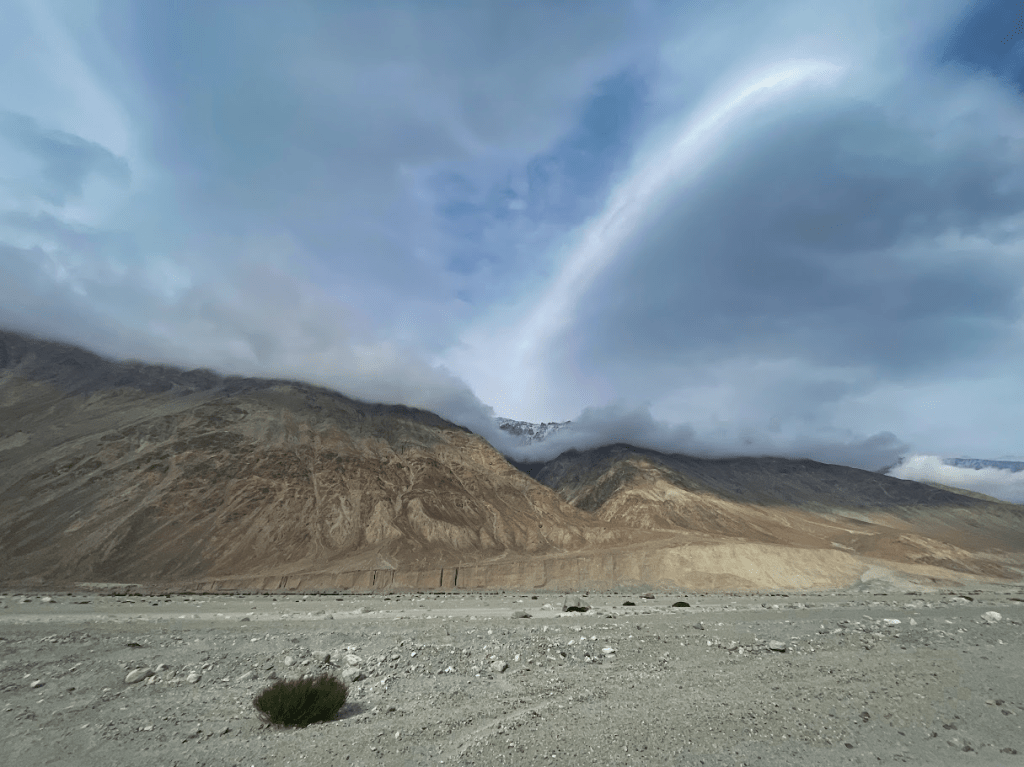
The Shyok River, which under the storm had seemed cold and severe, now flowed with a softer radiance, pale blue-green beneath the evening light. Along its banks appeared scattered patches of willow and poplar, small cultivated fields, and long grasses trembling beside the water. Against the immense barrenness of Ladakh, this narrow ribbon of green possessed an almost unbearable gentleness.
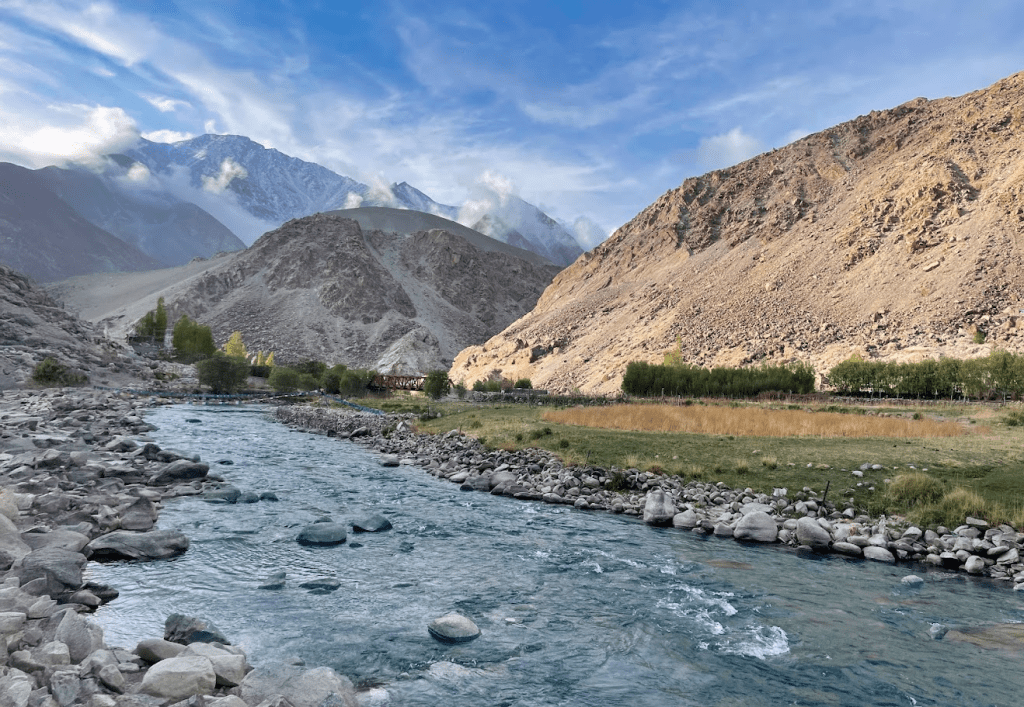
To the south, above the brown ridges and scree slopes, a snow-covered mountain rose suddenly into the clear sky — remote, silent, and astonishingly bright in the late sun.
Durbuk
After a quick lunch at a small roadside place near Tangtse, we crossed the Shyok once more and turned northward into the Durbuk Valley — the long high valley that slowly ascends toward Pangong Tso.
The landscape changed almost immediately.
Gone were the harsh gravel flats and broken riverbeds we had travelled through earlier. Durbuk valley opened instead into wide upland meadows — soft green marshlands spread beneath immense barren mountains. Thin streams wandered lazily across the valley floor, dividing and rejoining through cushions of bright alpine grass that seemed almost unreal against the pale mineral slopes surrounding them.
The mountains themselves remained severe: enormous ridges of ash-gray and ochre stone rising abruptly into the sky, stripped bare of forest or snow except upon the farthest summits. Yet between these desolate walls flowed water everywhere. Meltwater descended quietly from unseen glaciers and spread itself across the valley in winding channels, feeding rich pastures where herds of sheep and goats grazed peacefully in the late afternoon light.
The sun had remained with us for some time now, and beneath that brief clearing the meadows of Durbuk Valley appeared gentler than before. Across the green flats we began noticing small movements among the grasses — quick, alert motions near scattered holes in the earth. Norboo smiled and said they were marmots.
These Himalayan marmots are among the quiet inhabitants of the high plateau, large mountain rodents that survive the severe winters of Ladakh by retreating deep into underground burrows beneath the frozen earth. Through the short summer months they emerge into the sunlight to feed, standing upright upon their hind legs like little sentries watching over the valleys. In these remote uplands, where life often hides itself carefully, their curious fearlessness felt almost surprising.
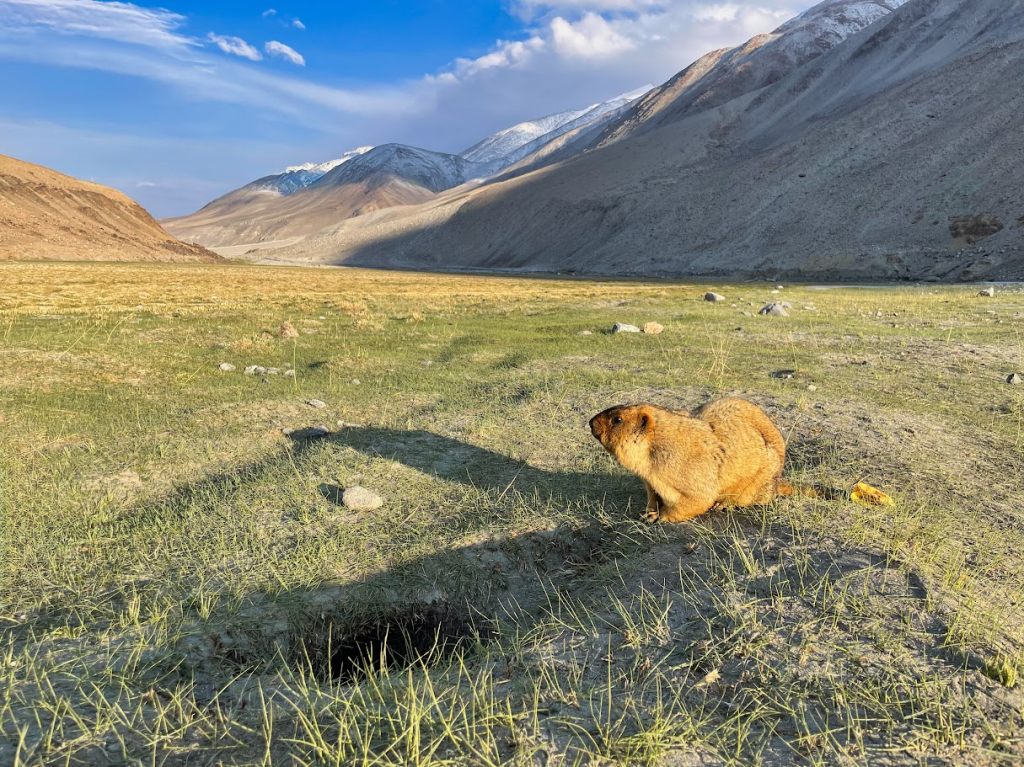
We stepped out of the vehicle and walked slowly across the meadow.
One marmot remained near its burrow, bathed in the golden evening light. Its thick fur glowed warm against the pale grasslands, and its dark eyes followed us with a kind of solemn curiosity rather than fear. Behind it the valley stretched away toward distant snow-streaked mountains, silent except for the faint sound of wind moving through the grass and the distant trickle of meltwater streams.
The creature sat motionless for some time, studying us as intently as we studied it. There was something oddly human in that gaze — cautious, thoughtful, almost contemplative. Then, with sudden decisiveness, it lowered itself and disappeared neatly into the dark opening of its burrow, vanishing into the hidden world beneath the meadow.
We lingered there for a while, hoping it might emerge again. But the mountains rarely permit stillness for long. Even as we waited, the light began to change. Shadows moved swiftly across the valley floor, and from beyond the ridges fresh clouds gathered once more, closing over the blue sky with the familiar suddenness of Himalayan weather. The wind turned colder. Norboo glanced upward toward the darkening mountains, and without needing to say much we understood it was time to move on.
Then without warning, the western sky broke open. A shaft of late sunlight fell across a solitary mountain ahead of us, and the entire slope blazed suddenly into gold.
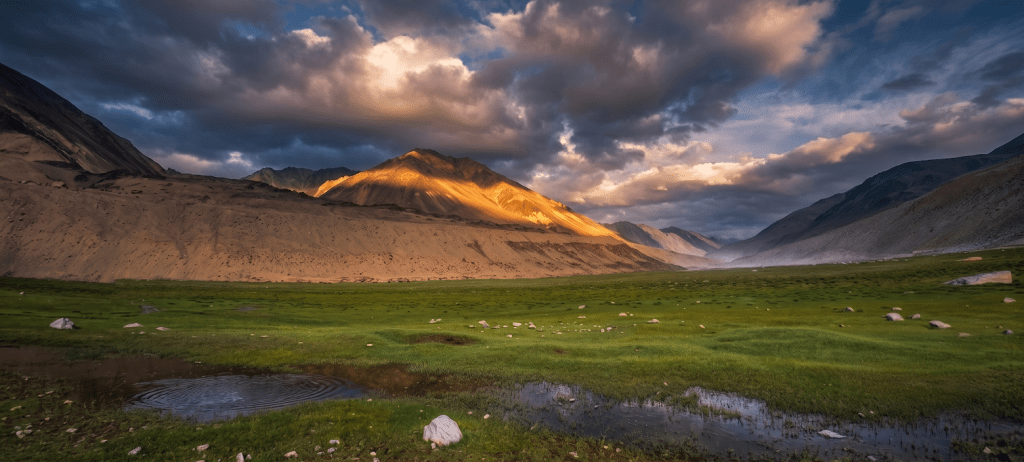
Everything around it remained subdued — the valley floor already sinking into shadow, the distant ridges cold and gray beneath the storm clouds — yet that one mountain burned with an almost impossible radiance, as though lit from within. The light moved across its barren face in long molten bands, illuminating every ridge with startling clarity. Above it the clouds gathered in enormous dark formations, heavy with rain, their undersides tinged violet and copper by the descending sun. The green meadows below deepened in color beneath the changing light. Small pools reflected fragments of cloud and sky, trembling faintly in the wind.
Such moments in the mountains possess a strange authority. They arrive suddenly, remain for only minutes, then disappear without explanation. One feels not merely that one is witnessing beauty, but that the landscape itself has revealed some hidden aspect of its character
Revelation
The anticipation had been growing quietly for hours as we drove deeper into the high valleys beyond Tangtse. Every turn in the road seemed to promise something just beyond the ridges ahead. Then suddenly, between two barren mountain slopes, a narrow glimmer of deep blue water appeared — a thin patch of lake glimpsed briefly through a gap in the rocks, so unexpected amid the cold desert that for a moment it scarcely seemed real.
Someone in the vehicle pointed silently toward it. Norboo smiled but said nothing. The road curved along the mountainside for a few more turns, rising and falling beside fields of stone, and with each bend the blue widened.
Then the valley opened completely, and Pangong Tso revealed itself.
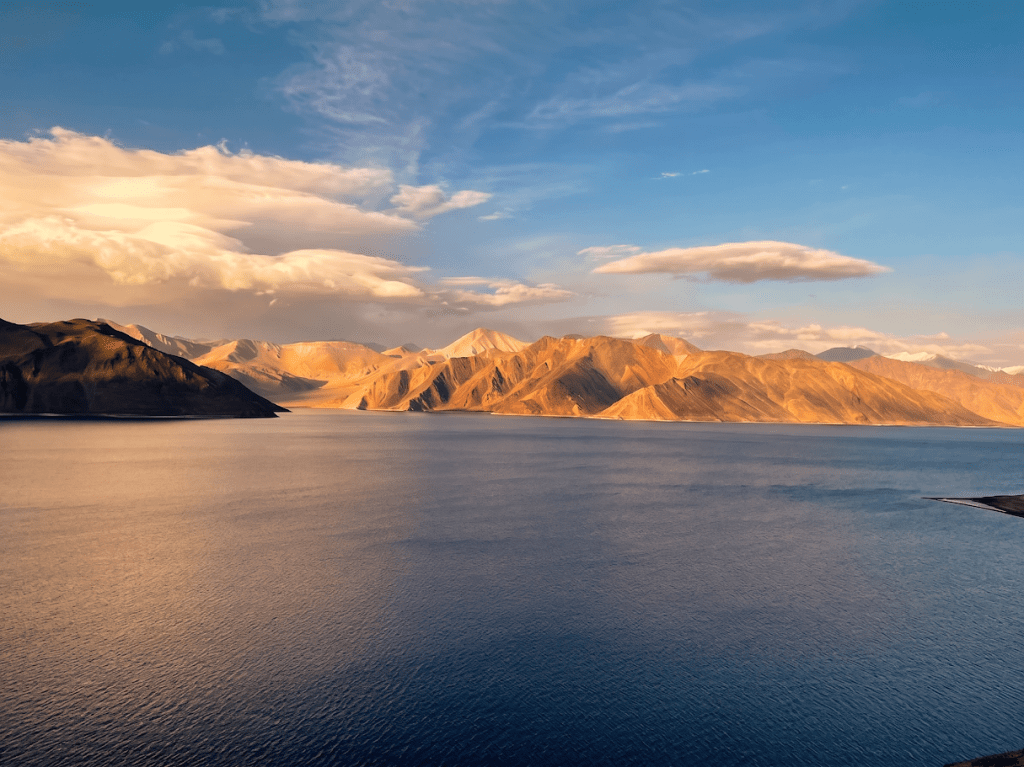
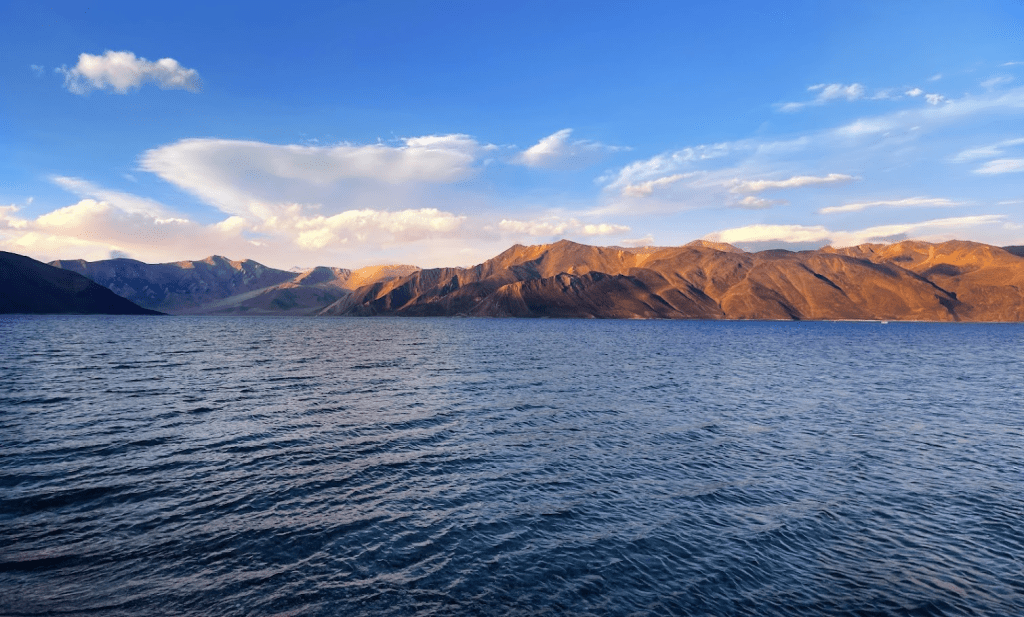
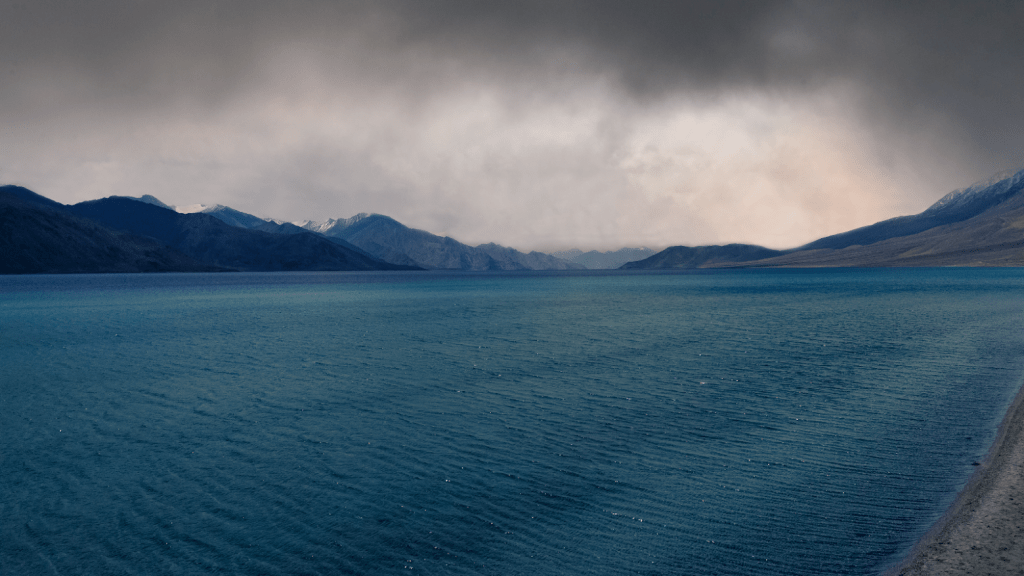
The lake lay immense beneath the evening sky, stretching eastward beyond sight into Tibet, its waters holding colors too subtle and shifting to be named properly — cobalt, indigo, silver-blue, at moments almost violet beneath the drifting clouds. Along its edges the mountains descended directly into the water without transition, bare slopes of ochre and ash reflected in broken fragments upon the restless surface.
Nothing in Ladakh prepares one entirely for Pangong.
After a long day among valleys of dust and stone, the sudden appearance of so vast a body of water at nearly fourteen thousand feet feels almost impossible, as though some fragment of sea had been lifted intact into the Himalayas. The lake is long — over a hundred kilometers from end to end — and most of it lies beyond the invisible frontier inside Tibet. No river visibly carries its waters away. It remains here enclosed among the mountains, fed by snowmelt, storms, and silence.
The evening light transformed the entire landscape. Sunlight broke through the western clouds and fell upon the mountains across the lake, setting their barren slopes ablaze in gold while the waters below darkened into deep cold blue. Above them drifted enormous Himalayan clouds, layered and luminous, their shadows moving slowly across the lake’s vast surface.
But the wind was wild.
It came rushing down the length of the lake in cold violent gusts, whipping the water into dark ripples and carrying with it the sharp taste of sand and dust. Jackets snapped loudly in the gale. The great lake, silent from afar, revealed itself up close as something untamed and restless, shaped constantly by altitude and weather.
Perhaps every traveler carries an imagined Pangong within the mind before arriving here — born from photographs, stories, cinema, or longing. But the real lake exists beyond those imaginings. It is colder, wilder, and infinitely more remote. And as the last light lingered upon the mountains and the dark waters stretched eastward into unseen lands, Pangong Tso seemed less like a destination reached than a threshold crossed into another order of landscape altogether.
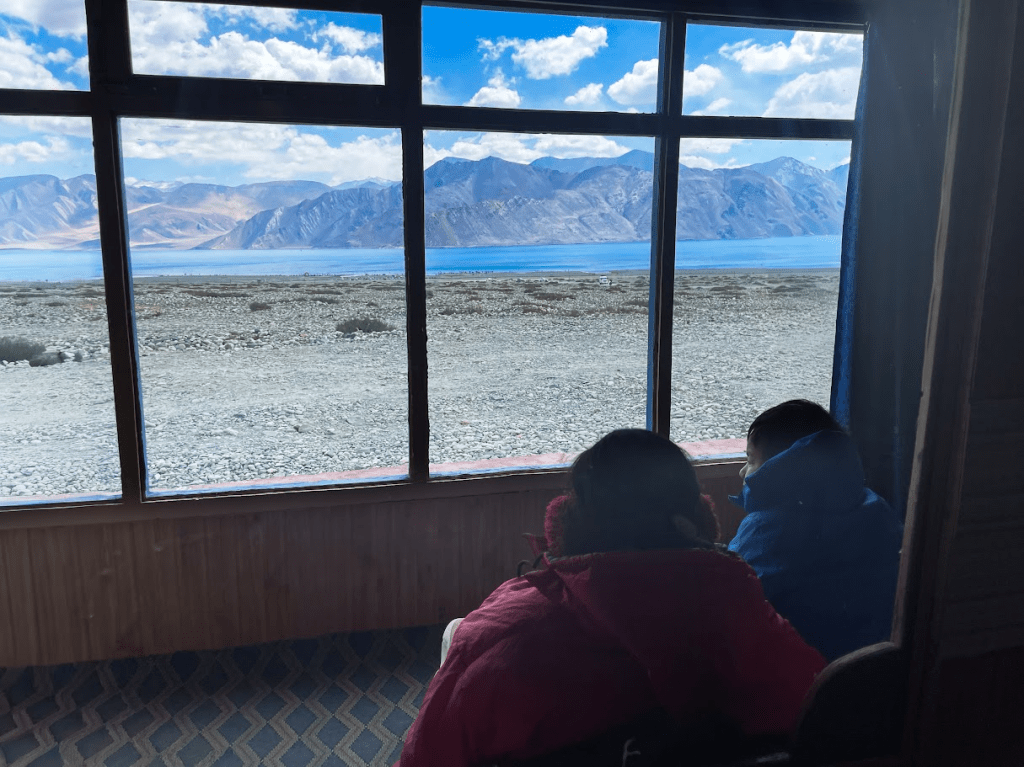
We dropped our luggage at Polaris Cottage, a cluster of cottages facing the lake. The room had large glass windows looking directly upon Pangong Tso without obstruction — nothing between us and the immense darkening waters except a barren strip of shore and the cold wind rushing endlessly down the valley.
We barely rested before walking toward the lake. Outside, the wind was brutal.
It came in violent gusts across Pangong, cutting through layers of clothing within moments and carrying with it the raw cold of 15000 feet and open water. The lake, which from afar had appeared serene and contemplative, revealed itself now as active with rippled waves crashing sharply upon the stony shore.
There was practically no one outside.
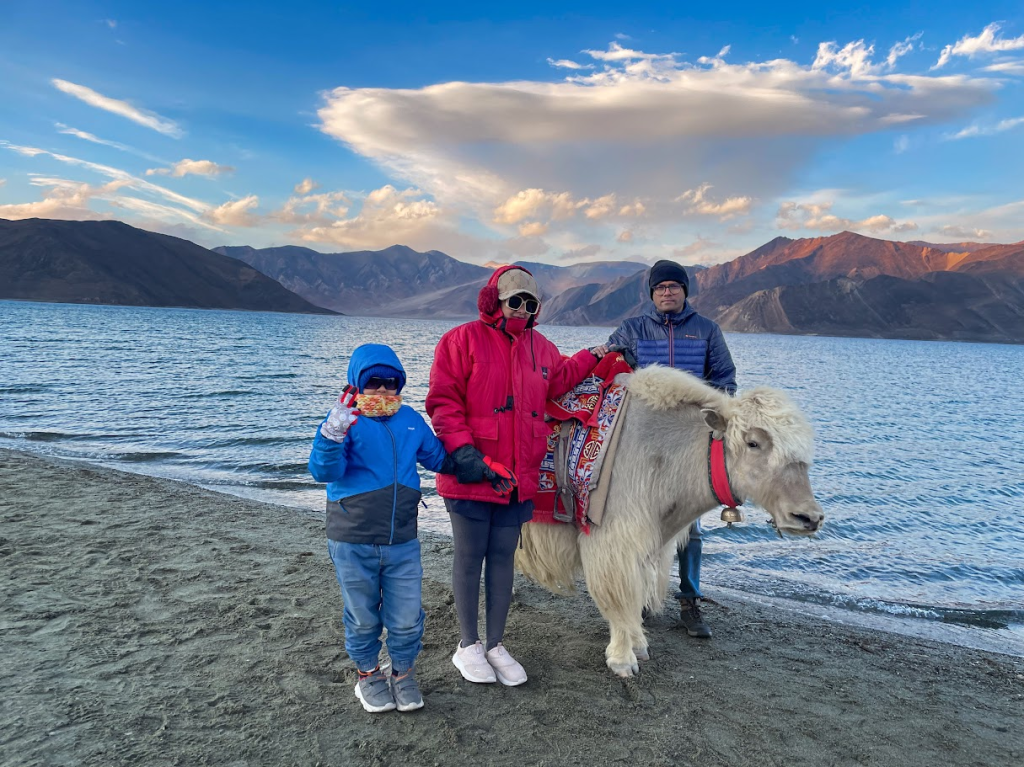
Near the shoreline stood a lone man beside a white yak, both nearly motionless against the darkening lake. The animal’s pale fur glowed faintly beneath the last evening light, while behind them the waters of Pangong had already begun losing their blue, deepening slowly toward iron-gray. The entire scene possessed a strange stark loneliness, as though the mountains themselves had emptied the landscape of human presence.
News of the storm near Chang La had spread by then. Most of the tourists attempting to come from Leh were had to go back. Those already at Pangong had little choice except to remain where they were and wait for morning. The cold, people said, would be severe tonight. Instead of the usual minimum temperatures around five or six degrees, the mercury was expected to plunge toward minus ten.
One could feel that possibility already descending with the darkness.
The warmth disappeared rapidly from the air as the sun withdrew behind the mountains. We stood by the lake only briefly before the cold became unbearable even through gloves and jackets. Fingers numbed almost instantly in the wind. Breathing itself seemed sharper here after sunset.
Back inside the cottage, the windows framed the final transformation of Pangong. The last bands of light faded slowly from the distant mountains, leaving behind only faint silver outlines beneath the deepening sky. The lake darkened by degrees until it became almost indistinguishable from the surrounding land — a vast black stillness stretching eastward into unseen borderlands. Above it, one by one, the first stars emerged in the clear Himalayan night.
Inside the room there was warmth at last — simple and deeply welcome. We sat quietly beside the great glass windows with hot coffee and bowls of steaming noodles in our hands while outside the wild cold gathered over Pangong Tso and the stars multiplied silently above the black waters.
The Night
Cold seeped through the walls and blankets with a persistence that felt almost alive. Outside, the wind moved continuously along the lake, striking the cottage in long violent gusts that filled the darkness with a low restless sound. Even indoors the air carried a bitter edge. Tandoor was lit and in another half an hour, things tended towards normal.
Around eleven at night I stepped outside. And immediately the cold ceased to matter.
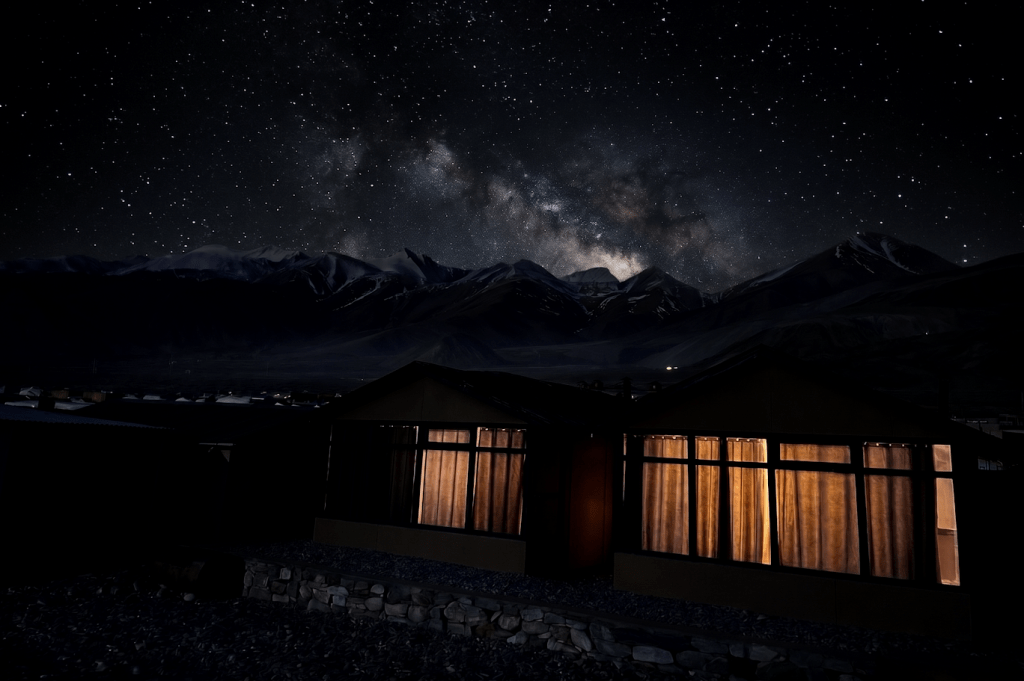
Beyond the softly glowing windows of Polaris Cottage, the mountains rose as vast black silhouettes against the sky, their snow-lined ridges barely visible in the faint celestial light. Above them stretched an astonishing sweep of stars — dense, innumerable, almost violent in their clarity at this altitude. The Milky Way arched across the heavens in pale luminous bands, suspended above the mountains like drifting cosmic dust. The sky did not appear distant here. It felt overwhelming and near, descending almost to the mountains themselves.
Below that immense sky the cottages glowed quietly from within, their curtained windows radiating amber light into the freezing darkness outside. They appeared fragile and temporary against the surrounding mountains — brief human shelters gathered beside the lake while beyond them stretched only wilderness, wind, and ancient stone. The night at Pangong did not feel merely cold or remote. It felt primordial.
Colours of Blue
Morning came bright and astonishingly clear.
When I drew back the curtain the eastern mountains across Pangong Tso were still half in shadow, their barren slopes cold and colorless beneath the first pale light. The lake too appeared subdued at first — gray-blue and metallic beneath the early morning sky, its surface restless under the continuing wind.
Then the sun rose slowly from behind the far ridges. Light touched the upper mountains first, spreading downward across the barren slopes in long golden bands while the snow upon the distant summits brightened suddenly against the blue morning sky. And as the sun climbed higher, Pangong awakened beneath it.
The lake began recovering its colors by degrees. Near the shore the water turned pale turquoise, so clear that the stony lakebed remained visible beneath the moving surface. Farther out it deepened into luminous blue-green, and beyond that into immense darker expanses of cobalt and indigo stretching eastward into Tibet. The colors shifted continuously with the movement of cloud and wind, so that different parts of the lake seemed to belong to different waters altogether.
One could sit for hours simply watching these transformations.
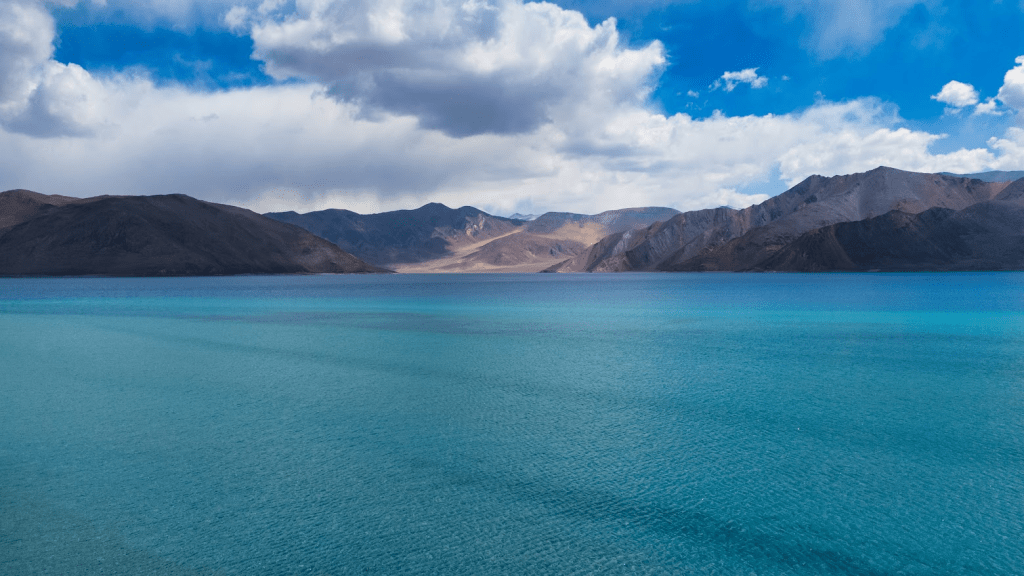
Above the lake the sky had cleared enough. Vast blue spaces opened between drifting white Himalayan clouds whose shadows moved slowly across the mountains and water. The storm of the previous evening seemed impossibly distant now, though fresh snow remained visible upon the high ridges behind the cottages, gleaming sharply in the clean morning light.
Along the curved sandy shore small groups of stranded travellers wandered quietly beside the water, tet even their presence felt diminished by the scale surrounding them. The lake remained immense and self-contained, indifferent to those who briefly arrived upon its shores.
From certain points the shoreline curved outward into pale sandbars extending into the blue water like unfinished brushstrokes. There the shallows glowed with extraordinary colors — translucent jade and turquoise merging gradually into darker blues farther from shore. Above them rose the naked mountains, stripped of all vegetation except occasional traces of snow in hidden folds and ravines
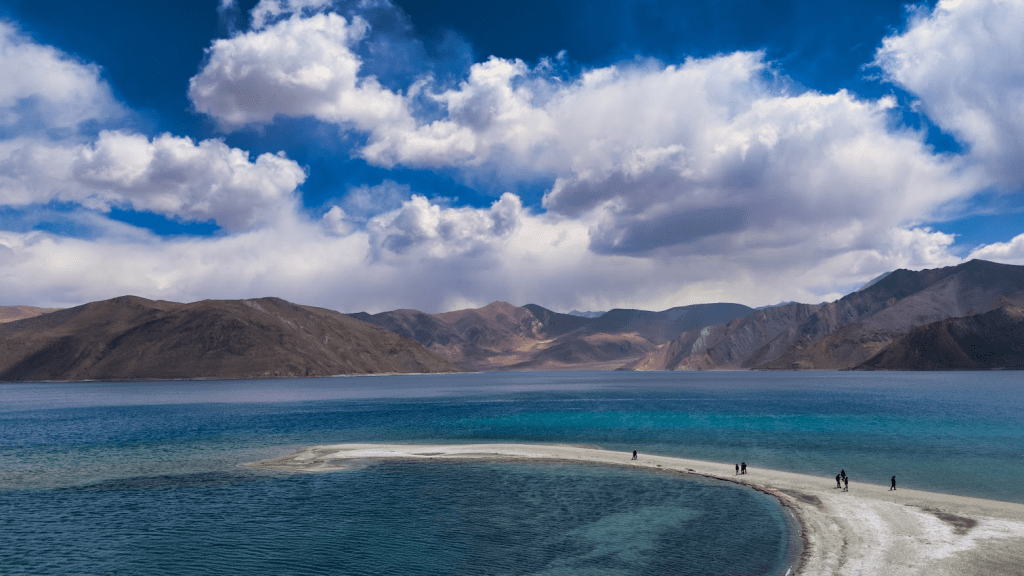
Behind the cottages the mountains stood closer and harsher, their upper slopes covered with fresh snow from the storm near Chang La. In the hard morning light their ridges appeared severe and almost sculptural, reminders that this beauty existed only because of the cold and desolation surrounding it.
There is a strange quality to mornings at Pangong. The lake appears serene, almost tender beneath the clear sky, yet beneath that beauty one continues to sense the rawness of the high plateau — the bitter nights, the thin air, the violent storms that can descend without warning. Perhaps it is this union of beauty and severity that gives Pangong its peculiar power over the imagination.
By midmorning the lake had become brilliantly blue beneath the open Himalayan sky, the clouds drifting slowly above it while the mountains watched silently from every side. And looking across those changing waters toward the empty eastern distances beyond the frontier, one felt again that curious sensation which returns often in Ladakh — not of standing at the edge of the world, but somewhere beyond the edges by which ordinary worlds are measured.
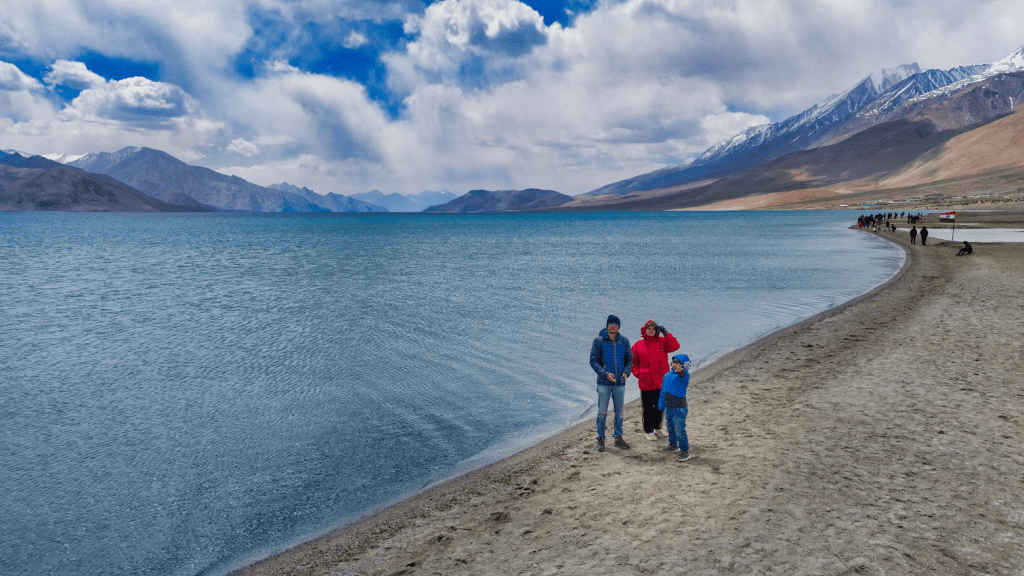
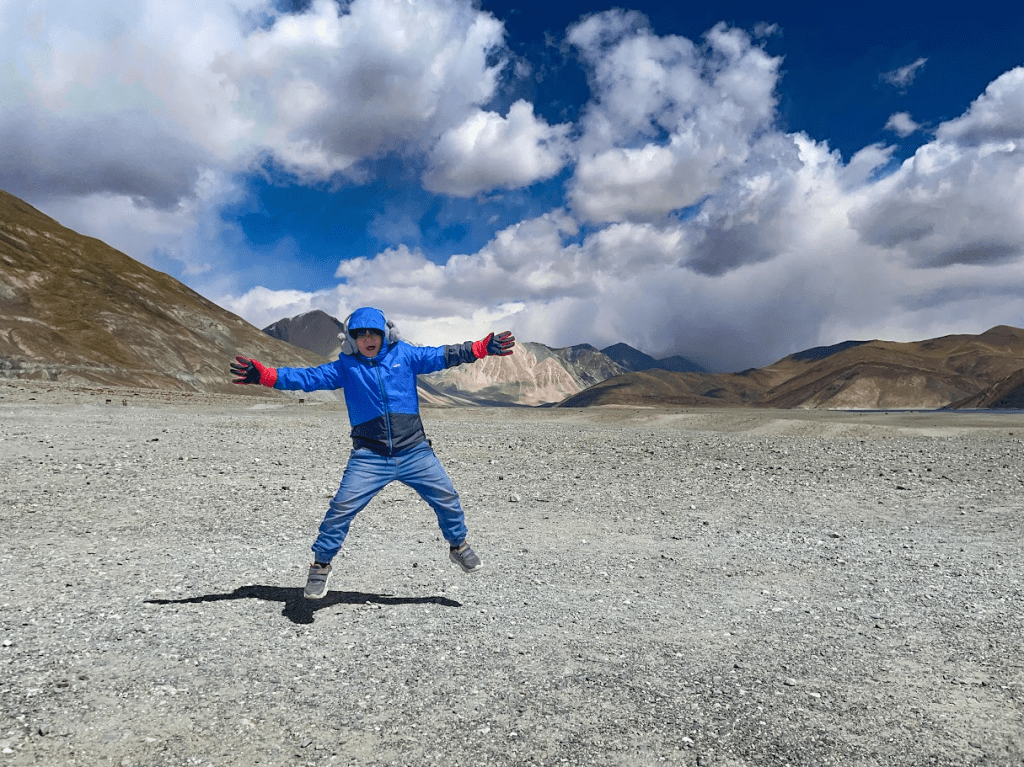
We wandered slowly along the shores of Pangong Tso through the bright cold morning, trying silently to absorb as much of the place as possible before departure. There are landscapes one merely sees, and there are others one attempts almost desperately to carry away within oneself, fearing that memory alone may not prove equal to them later.
Photographs preserve the appearance of a place, but memory preserves its weather, its silence, the feel of the wind against the face, the strange inward movement of thought beneath immense mountains. Years later one rarely remembers an image exactly as it was framed; instead one remembers the cold in the fingers while holding the camera, the sound of distant water, the loneliness of clouds moving over Pangong. Memory softens and deepens a landscape at once, until the place no longer exists merely outside oneself but somewhere within.
The wind had begun rising again by then.
Across the lake long dark ripples moved steadily eastward, and the white clouds that had floated harmlessly through the morning sky were thickening above the western ridges. Norboo walked toward us from the cottages with the practical calm of mountain drivers and said the weather around Chang La might deteriorate again later in the day. If we wished to cross safely toward Leh, it would be best to leave before noon.
Still, there remained time enough for one last wandering along the shoreline.
Near one stretch of beach stood the curious remnants of cinema — brightly colored props left from the film 3 Idiots, incongruous against the austere immensities of Pangong. Travellers gathered there laughing and posing for photographs in the thin cold air. We too participated briefly in this small ritual of modern pilgrimage before drifting away again toward quieter stretches of shore where only the wind and water remained.
By the time we finally returned toward the vehicle, the lake had changed once more.
The still luminous blues of the morning were darkening beneath the shifting clouds. Wind swept strongly across the water now, raising restless waves that broke sharply upon the shore. The calm reflective Pangong of dawn had vanished. In its place the lake appeared wilder again, colder and more remote beneath the gathering sky.
Far above the mountains, the clouds were thickening into darker formations, moving steadily toward the passes.
As we drove away along the shore road, Pangong Tso remained visible for a long while behind us — immense, wind-streaked, and increasingly shadowed beneath the returning weather, as though the mountains, having briefly revealed the lake in all its clarity, were now slowly drawing their veil across it once more.
The Chang La
We were once again driving through the Durbuk valley.
Far inside the upper reaches of the Durbuk valley we came upon a solitary shepherd woman standing beside a narrow stream that wandered through the greens beneath the mountains. Her face was deeply weathered by altitude and wind, the skin darkened and roughened by years beneath these immense skies. Yet there remained a quiet dignity in her bearing, in the way she held the long wooden staff across her shoulders while the cold valley wind moved through her loose hair and faded clothes.
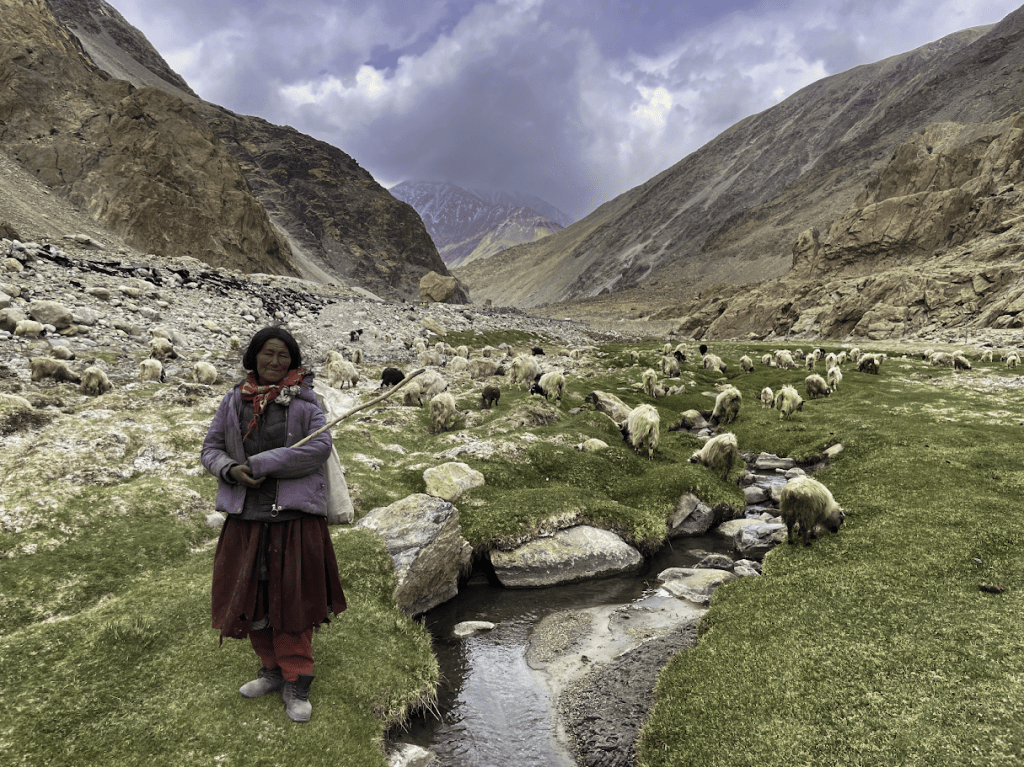
The valley itself possessed that strange Ladakhi contrast where barrenness and fertility exist side by side with almost violent abruptness. On either side rose enormous walls of naked rock — gray, ochre, and ash-colored mountains stripped nearly bare of vegetation, their slopes fractured by ancient landslides and frozen scree. Above them heavy clouds gathered again around the higher ridges, obscuring the snow peaks in drifting curtains of shadow and light.
Yet on the valley floor water moved quietly through channels of astonishing green.
Norboo told us these were nomadic people who shifted camp according to season and pasture, moving through the valleys with their herds as generations before them had done. In summer they ascend toward the higher grazing grounds; before winter they descend again to less hostile elevations. Their lives remain tied not to roads or towns but to vegetation, snow, water, and the moods of mountain weather.
Standing there beside the narrow stream, with her flock spreading across the green valley floor beneath gathering storm clouds, the woman seemed less an isolated figure than part of the landscape itself — as ancient and weather-bound as the mountains surrounding her. Only the sound of water moving between stones and the distant grazing of animals remained beneath the enormous silence of the Himalayas.
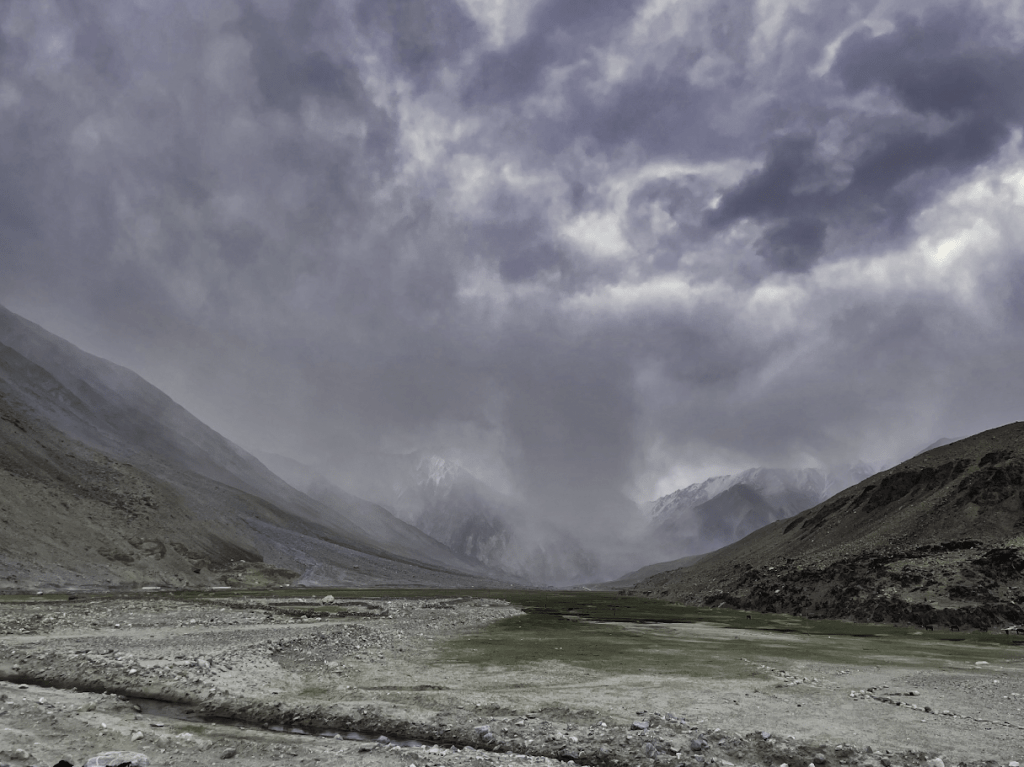
The road ahead acquired a bleakness that felt almost foreboding. Far ahead, beyond successive folds of barren mountains, lay Chang La — hidden now beneath thickening storm clouds. The mountains themselves seemed to darken as we approached them, their upper ridges dissolving into curtains of snow and drifting vapor.
Then the valley opened briefly and we saw the storm fully.
Across the immense gray landscape, clouds descended violently into the mountains like collapsing walls of smoke. Snow or sleet appeared to be falling somewhere within that shifting whiteness, though distance made it impossible to tell where sky ended and mountain began. The higher ridges surfaced only intermittently through the storm — pale ghostlike forms buried beneath moving cloud.
Below those enormous skies the valley floor stretched outward in desolate emptiness.
Norboo grew quieter.
He glanced repeatedly toward the mountains ahead and finally said we needed to cross Chang La as early as possible. If the weather worsened, snowfall or ice could make the pass dangerous by evening.
In Ladakh distances deceive the traveller. A place appearing near may still remain hours away through mountain roads and high passes. And unlike lower Himalayan regions where villages appear frequently, much of Ladakh possesses an immense emptiness. Once outside the larger settlements, one moves through vast stretches of cold desert where there may be nothing for many miles except rock, wind, and military camps. If stranded in worsening weather, there are often few possibilities for shelter. Many places here truly feel beyond the edges of habitation — valleys where night and storm arrive without witness.
As we drove toward the ascending road to Chang La, that awareness settled gradually upon us.
The climb toward Chang La began beneath a dim metallic sky.
Almost immediately the evidence of the previous day’s storm became visible. Fresh snow lay scattered across the mountainsides in pale irregular streaks, powder-like and delicate, as though the storm had only just withdrawn from the pass a few hours earlier. The barren brown slopes we had seen from Pangong were now dusted lightly in white, transforming the entire landscape into something colder and more austere.
The road climbed steadily through long barren curves.
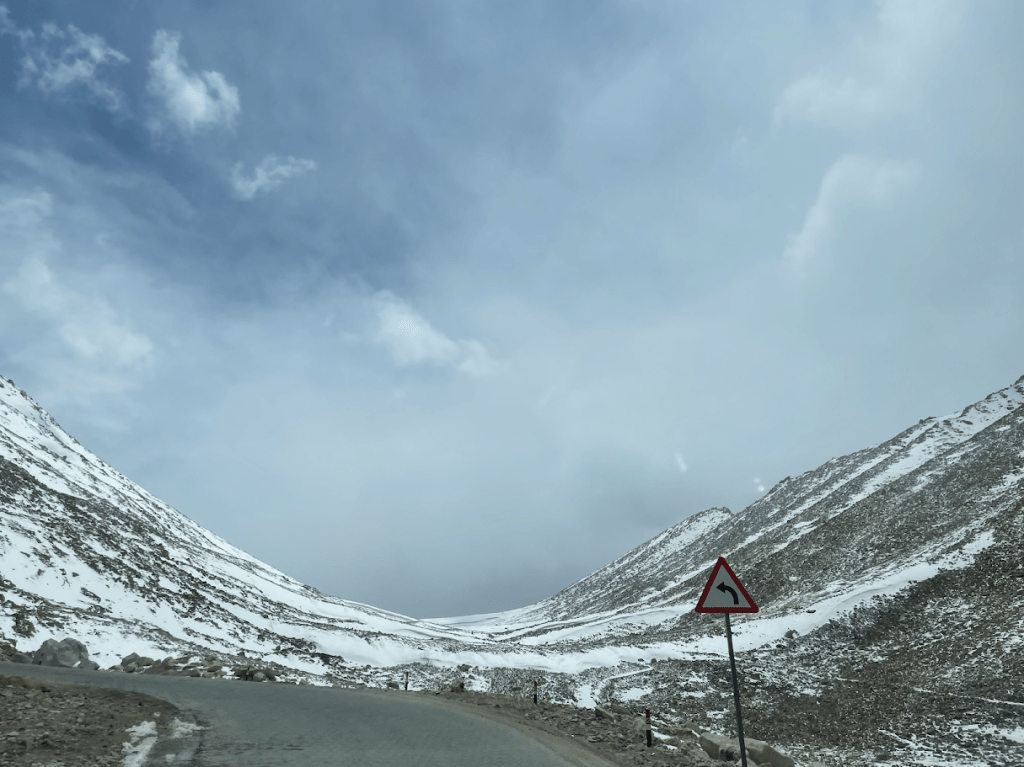
Beside us narrow streams moved sluggishly beneath thin sheets of ice while above, the mountains rose in immense silent walls streaked with snowfields and frozen scree. The higher we ascended, the more winter seemed to reclaim the land. Snow gathered thickly along the roadside and filled the hollows between rocks. The wind sharpened again, carrying with it fine particles of snow that drifted low across the ground.
Below us the road twisted downward into the vast empty valley through which we had come — thin improbable ribbons of asphalt crossing a world otherwise ruled entirely by stone and weather.
Higher still, vegetation disappeared completely.
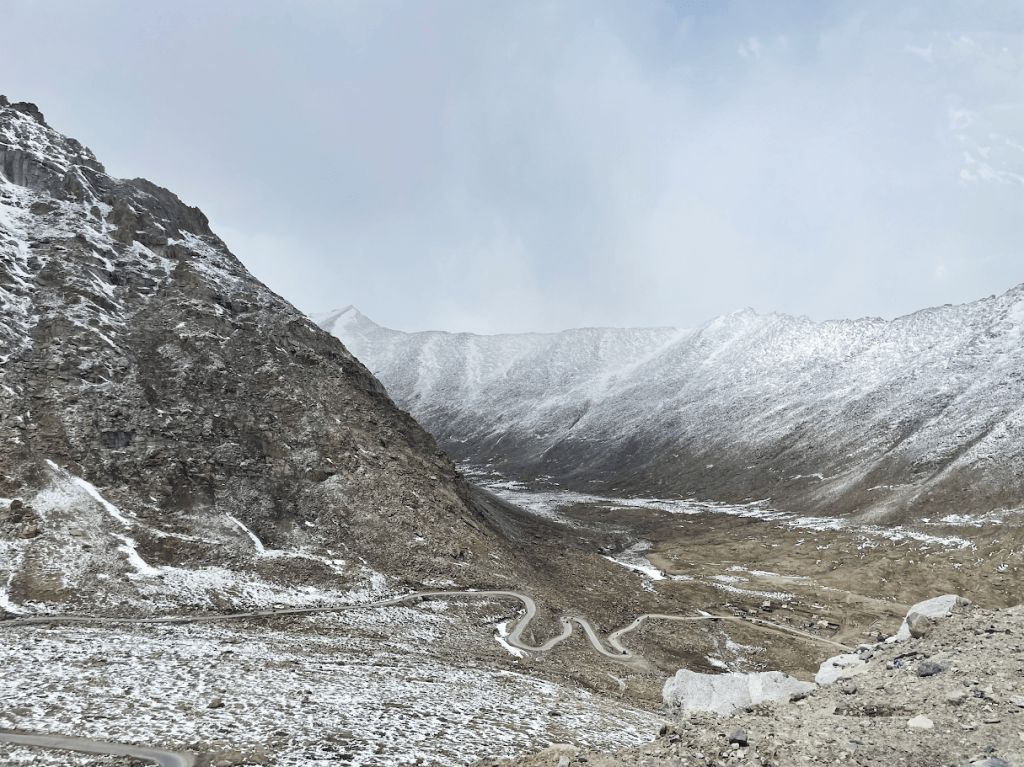
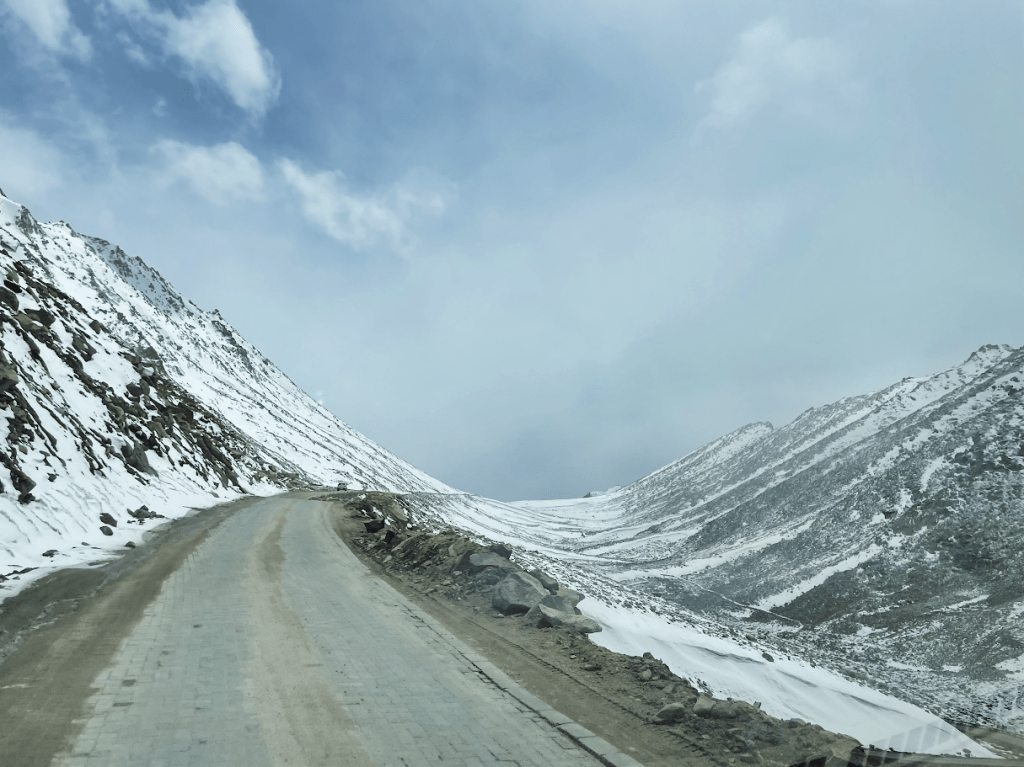
There remained only snow, rock, sky, and the narrow mountain road climbing through them. The mountains around Chang La possessed none of the softer grandeur of forested Himalayan passes farther south. These were stark trans-Himalayan heights — severe, exposed, and elemental, shaped by cold rather than rain.
By the time we reached Chang La itself, nearly everything around us lay covered in snow.
At over 17,500 feet, Chang La is among the highest motorable passes in the world, linking the Indus valley with the remote eastern regions around Pangong. Yet despite the signboards and occasional military presence, the pass does not feel like a destination so much as a temporary opening through hostile mountains — a place where weather changes swiftly and human beings linger only briefly.
Snow covered the slopes, the prayer flags, the roadside stones, even the roofs of the small structures near the summit. The air there felt startlingly thin and cold. Breathing required a quiet deliberate effort, and even simple movement carried a faint heaviness at that altitude.
We stopped only briefly.
Norboo, practical as always, warned us not to remain longer than thirty minutes. Storm clouds were still gathering beyond the ridges and the descent toward Leh remained long.
But for Satyaki the pass had instantly become another world altogether.
The cold, the altitude, the warnings — none of it mattered beside the sudden abundance of snow. While we stood watching the immense white mountains beneath the restless sky, he threw himself completely into the landscape, running, laughing, kicking through the fresh powder, gathering snow in gloved hands as children instinctively do in places that to adults feel harsh or dangerous.
There was something strangely heartening in that sight.
Perhaps children experience mountains differently from grown travellers. Where adults perceive risk, isolation, and weather, children often discover only wonder — snow to touch, wind to chase, immense open spaces in which to move freely. Watching Satyaki play upon the snow-covered summit of Chang La beneath those enormous Himalayan skies, one felt briefly released from the anxieties of roads and storms that had occupied us since Pangong.
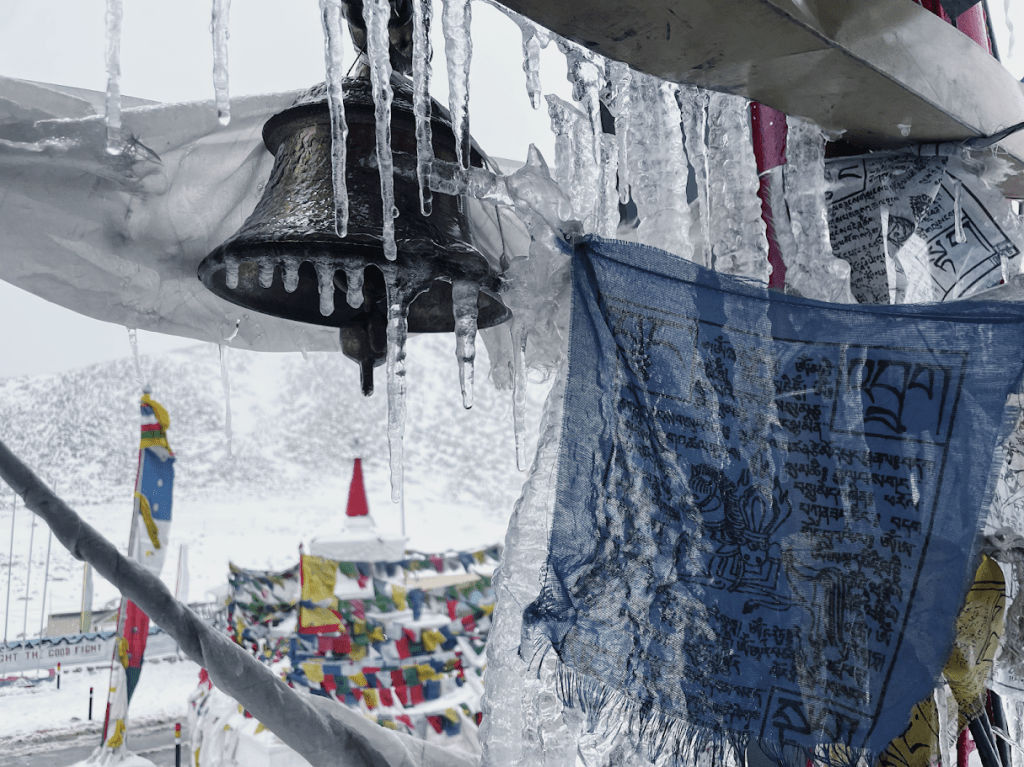
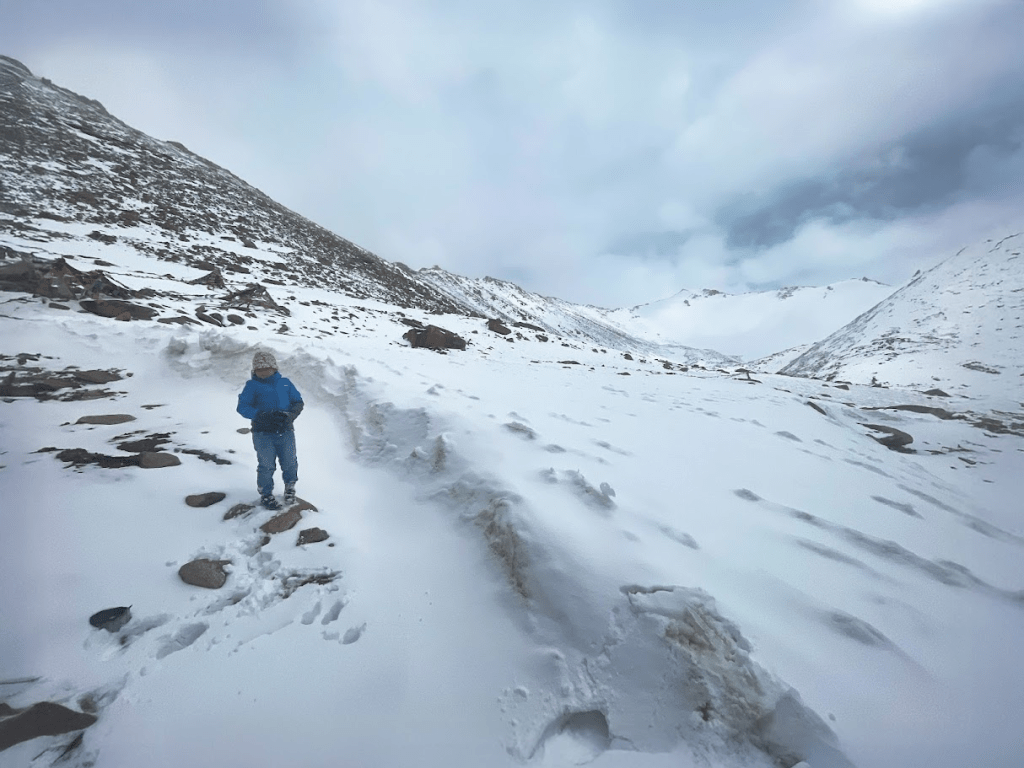
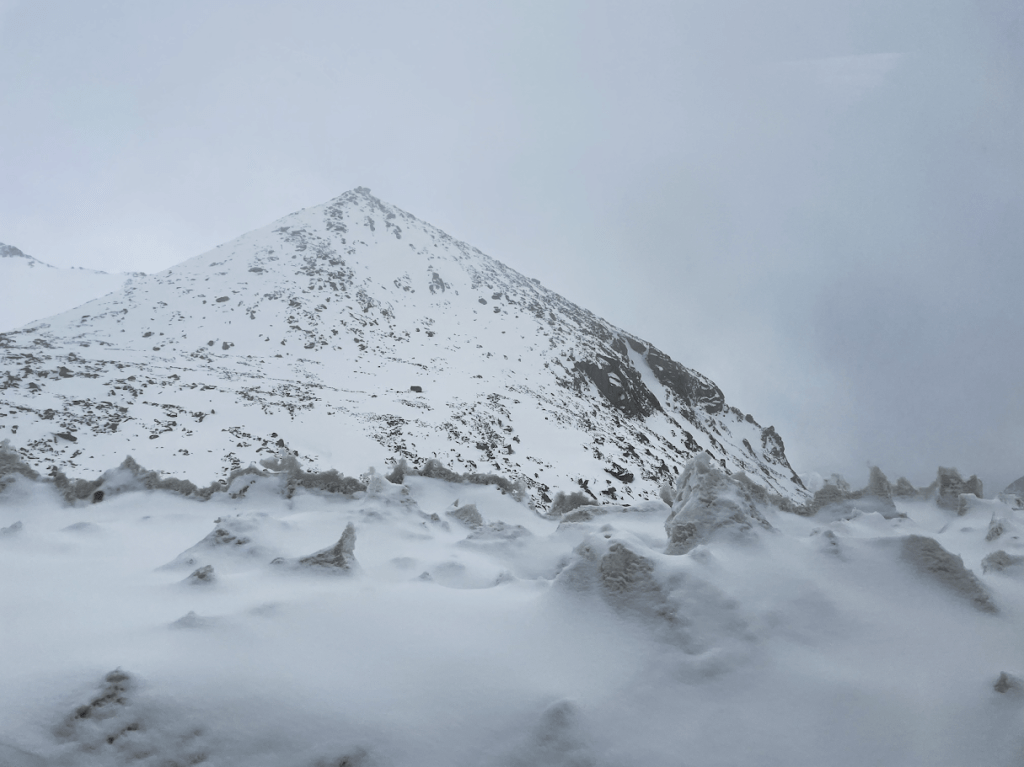
Clouds drifted low again across the upper ridges, and after some time Norboo called us back toward the vehicle. Reluctantly we left the snowfields behind and began descending westward from Chang La, leaving the white silent heights gradually behind us.
It proved a wise decision to leave Chang La early.
Not long after beginning the descent, the weather closed in completely. Snow began falling steadily across the pass, at first in scattered flakes moving sideways in the wind, then in denser sweeping currents that blurred the mountains and road alike. Visibility narrowed sharply. The windshield whitened continuously and the wipers moved at full speed against the accumulating snow and sleet while Norboo drove with complete concentration through the winding descent.
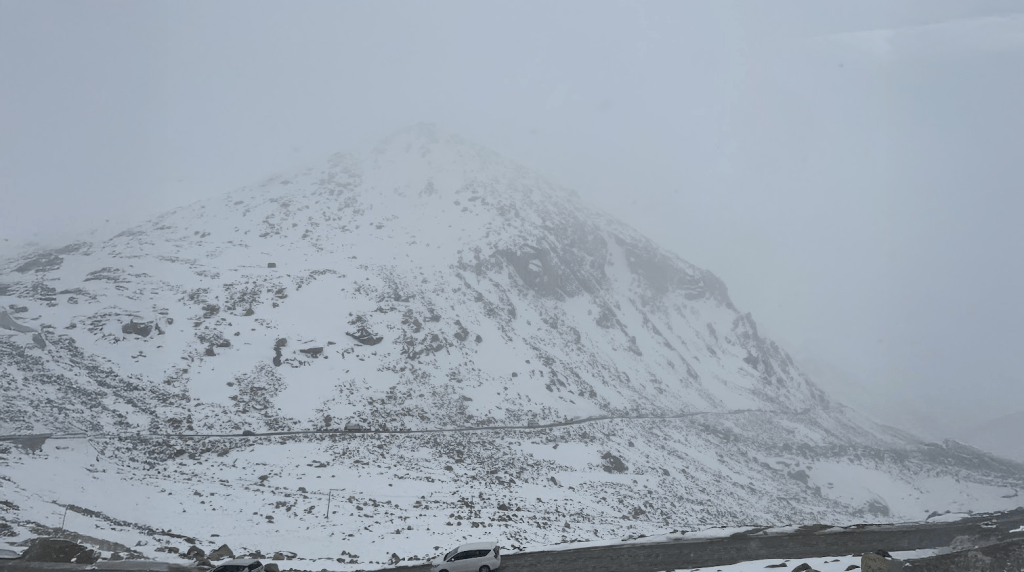
Mountain roads in such weather possess their own quiet tension.
The turns are blind, the edges uncertain, and beyond them lie immense drops vanishing into cloud and snow. Yet Norboo seemed almost part of the road itself, reading instinctively what remained hidden to us — the changing surface, the approaching bends, the moods of the mountain weather.
For perhaps half an hour we moved through that shifting whiteness.
Then, as suddenly as it had begun, the storm weakened. Snow became rain, rain became mist, and eventually only heavy clouds remained above the valleys. The mountains reappeared gradually through drifting vapor, dark and wet beneath the retreating storm. Lower down, traces of vegetation emerged once more beside streams and settlements, and the severe white world of Chang La receded behind us.
Near Chemrey Monastery we stopped briefly.
The monastery rose upon its rocky hill beneath a dramatic sky, its whitewashed buildings climbing upward toward the larger structure crowning the summit. Dark clouds gathered heavily above it, immense and sculptural against the barren Ladakhi mountains, yet the monastery itself appeared strangely serene within that turbulent landscape — resilient, weathered, and enduring in the ancient Himalayan manner.
Prayer flags fluttered faintly in the wind.
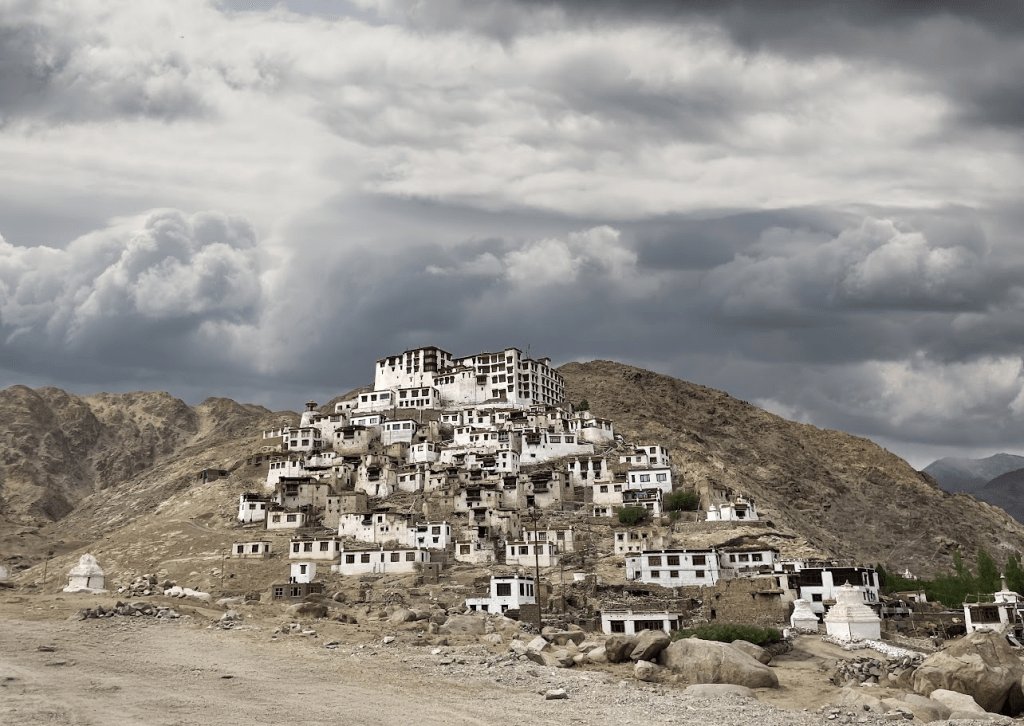
Standing there after the storm and the long crossing from Pangong, one felt again that peculiar stillness which monasteries in Ladakh often evoke — not peace exactly, but continuity. Human life here has always existed beneath harsh skies and among difficult mountains. Storms pass, snow falls, roads vanish and reopen, travellers come and leave, yet the monasteries remain watching over these valleys century after century.
As we resumed our drive toward Leh, evening light began breaking slowly through the western clouds.
And gradually the journey itself acquired that strange quality by which travel passes into memory.
The storms over Shyok, the nomadic shepherd in the green valley, the marmots beside their burrows, the immense blue silence of Pangong, the brutal cold night beneath innumerable stars, the snow-covered ascent to Chang La — all these moments, once immediate and physical, had already begun settling inward into something quieter and more enduring.
Perhaps this is why certain journeys remain with us long after others fade.
Not because of distance travelled or places merely seen, but because somewhere along the road the external landscape begins entering the inner one. The mountains alter the scale of thought. Vast silences expose hidden restlessness within us. One returns outwardly to ordinary life, yet some inward part continues wandering among those high valleys long afterward.
Even now, when I think back upon that journey to Pangong Tso, it is not a single image that returns first.
It is the movement of weather.
Clouds advancing across barren mountains. Wind moving over blue water. Snow descending upon Chang La. Stars burning above the black lake. The Himalayas seemed alive not through permanence but through ceaseless transformation — harsh, beautiful, indifferent, and deeply humbling.
And somewhere beyond memory, beyond photographs and words, Pangong itself still remains there beneath the moving sky — immense, cold, and silent among the high deserts of Ladakh.
 Mustard Feet's Journeys
Leave a comment