
There are places in the hills that become destinations, and then there are places that quietly remain memories. Takdah felt like the latter from the very beginning.
While the roads to Darjeeling keep carrying endless waves of tourists, honking vehicles and crowded viewpoints, Takdah seemed to sit silently somewhere beyond all that noise — hidden beyond the forests, tea gardens and drifting mountain clouds. We had heard about it in fragments before. A quiet village. Old colonial bungalows. Pine forests. Mist. But nothing really prepares you for the strange calm the place carries.
Just after crossing Ghum, the road suddenly turned right, almost as if leaving behind the familiar rhythm of Darjeeling altogether. The traffic thinned. The noise faded. And slowly, the tall pine forests of Lamahatta began appearing around us like silent guardians.
The mountains here felt different. Quieter. Older somehow.
The road curled through deep pine forests where sunlight struggled to reach the ground. Fallen leaves covered parts of the roadside like a rust-coloured carpet, and the air carried that unmistakable damp mountain smell of moss, wood and mist. Occasionally the forest opened up for a few seconds to reveal distant green slopes before swallowing the road once again.
Then came the narrow forest stretch that almost felt like an entry gate into Takdah itself. It was not grand in any obvious way, yet there was something cinematic about it — the winding road disappearing into trees, the sudden silence, the soft mountain fog drifting lazily between the branches.
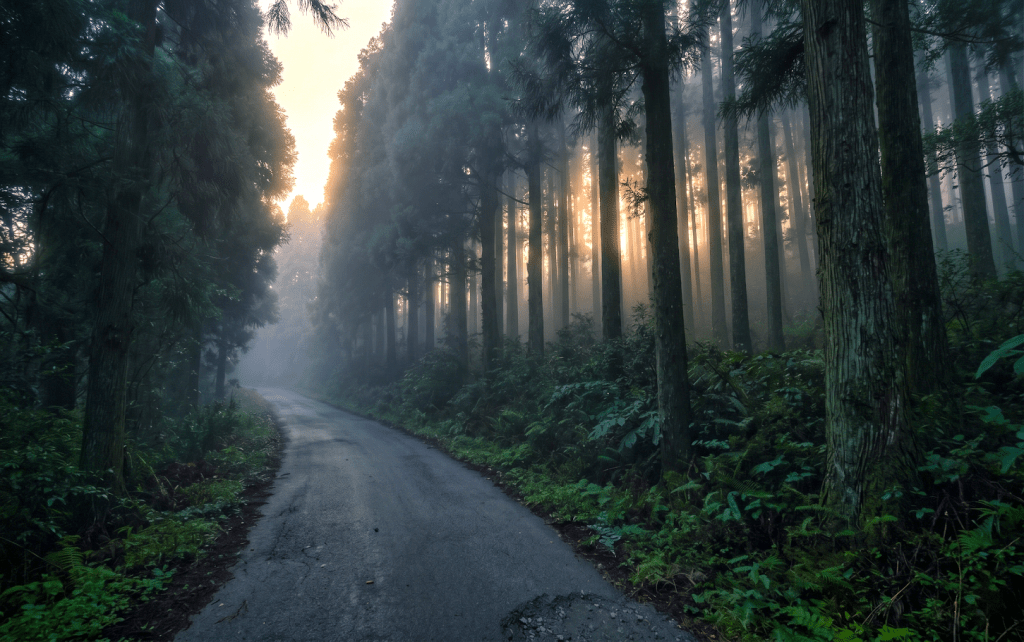
And then, almost without announcement, quiet little Takdah appeared among tea gardens and forests. Unlike Darjeeling, Takdah does not try to impress immediately. It reveals itself slowly. Colonial-era bungalows stood scattered with the forest trees hovering at the back, their old walls carrying traces of another century. Pine trees towered over narrow roads while mist moved gently across the slopes as if the hills themselves were breathing slowly.
Takdah was once an important British cantonment during the colonial period, and even today, echoes of that forgotten past remain hidden across the landscape. But unlike the busy colonial hill stations that grew louder with tourism, Takdah somehow remained untouched — peaceful, unhurried and deeply intimate.
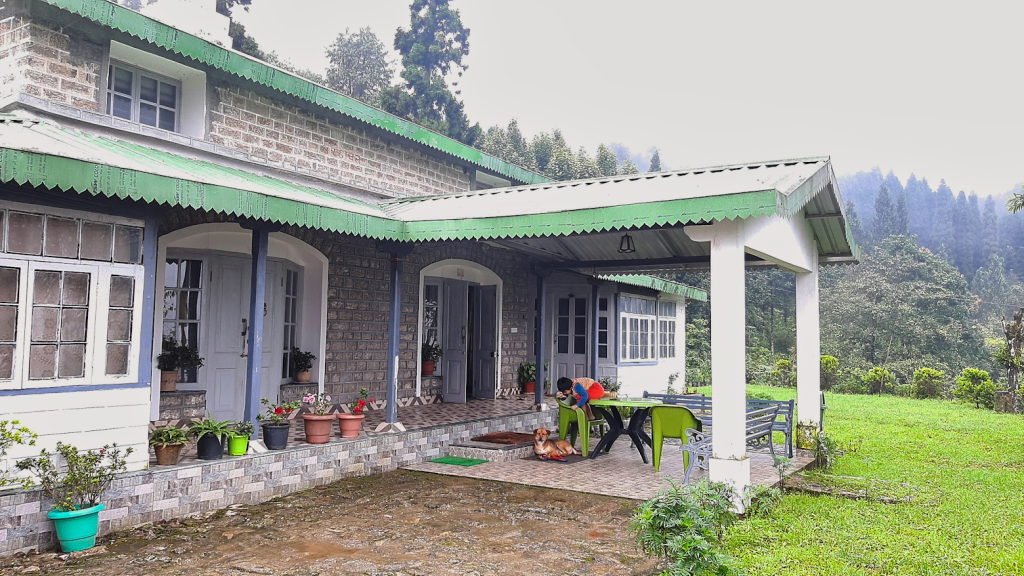
Our stay in Takdah turned out to be one of those old colonial bungalows that almost seem inseparable from the hills themselves.
The road climbed gently for a while before stopping near a small elevation, and there it stood quietly in the mist — stone walls, green sloping roofs, long glass windows and deep silence all around. Behind the bungalow rose a dark forest of tall pine trees, their outlines fading into clouds that kept drifting slowly across the hillside. The entire place looked as if it had been resting there untouched for decades.
There was something deeply comforting about the bungalow from the very first glance. Not luxurious in the modern sense, but warm, old and full of character.
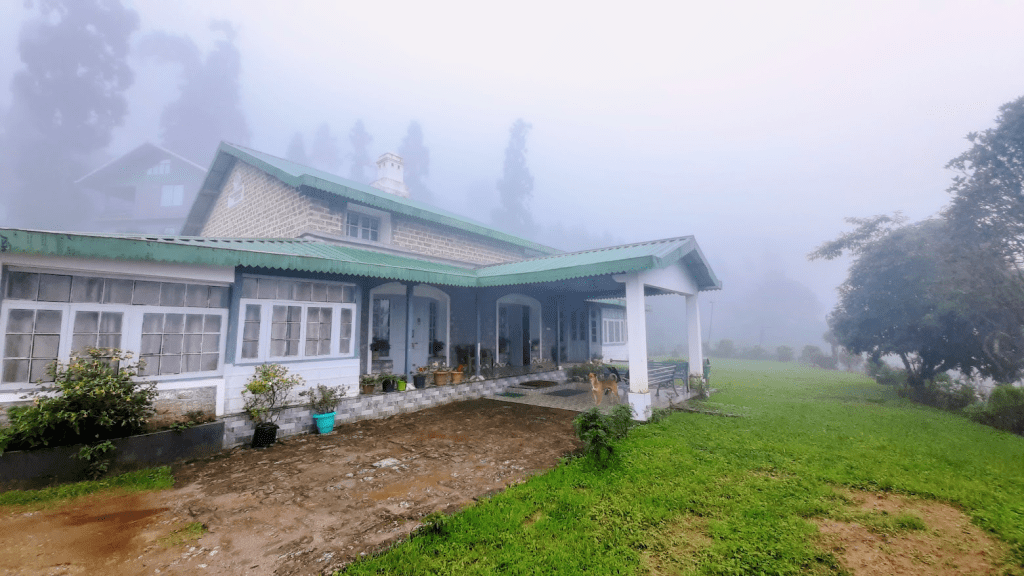
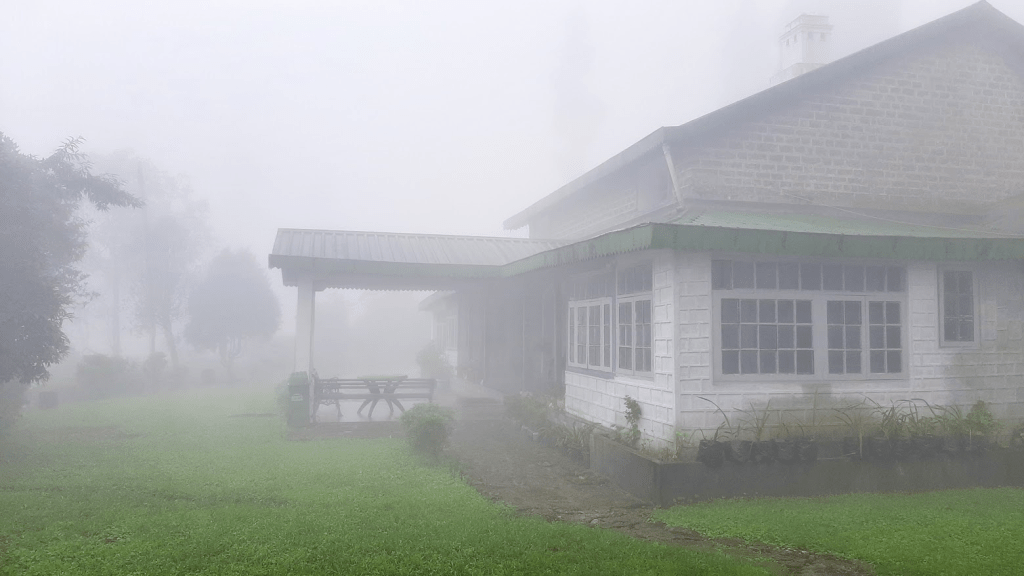
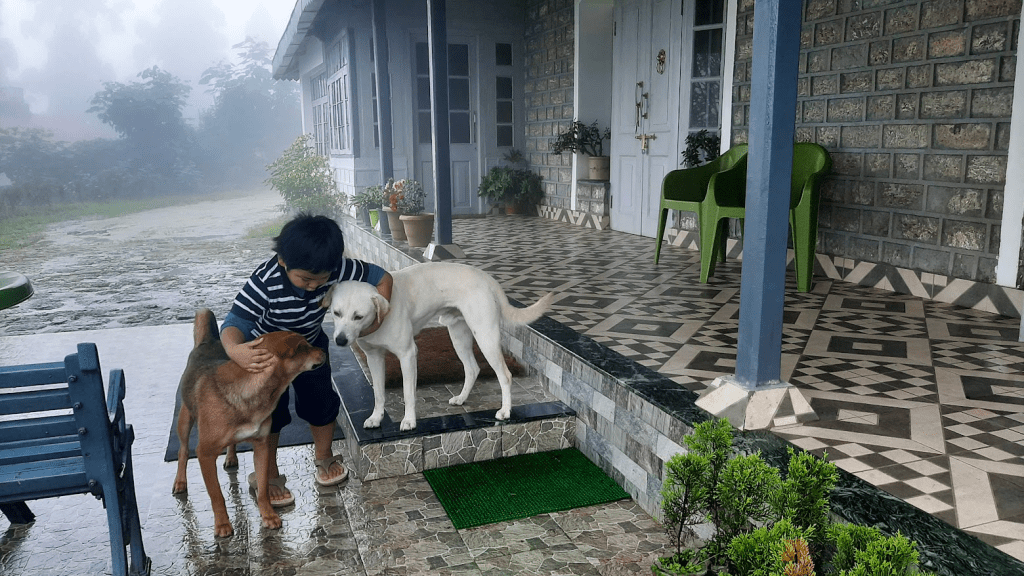
The verandah opened towards a wide green lawn where the mist wandered freely through the morning hours. Somewhere nearby, invisible birds kept calling from inside the forest. The air smelled of wet grass, pine wood and rain-soaked earth. Two local dogs had quietly made the bungalow grounds his kingdom and within minutes Satyaki had already found new friends.
Inside, the rooms still carried traces of their colonial past. Wooden furniture creaked softly against the silence, the large windows opened towards endless greenery, and at the centre stood an old fireplace with dark polished woodwork surrounding it — perhaps once the heart of countless cold mountain evenings from another era. Looking at it, it was easy to imagine British officers and travellers gathering around the fire while rain lashed against the hills outside.
What we loved most, however, was the strange stillness of the place.
Clouds kept arriving silently from the forests behind the bungalow, covering everything for a few minutes before slowly dissolving again. Sometimes the entire surrounding disappeared into white mist, leaving only the faint outline of pine trees visible in the distance. And then suddenly, the hills would return once more.
Takdah did not feel like a tourist destination at all at that moment. Sitting in the verandah with warm tea while the forest disappeared into clouds behind the bungalow, it felt more like we had borrowed a forgotten little corner of the Eastern Himalayas for ourselves.
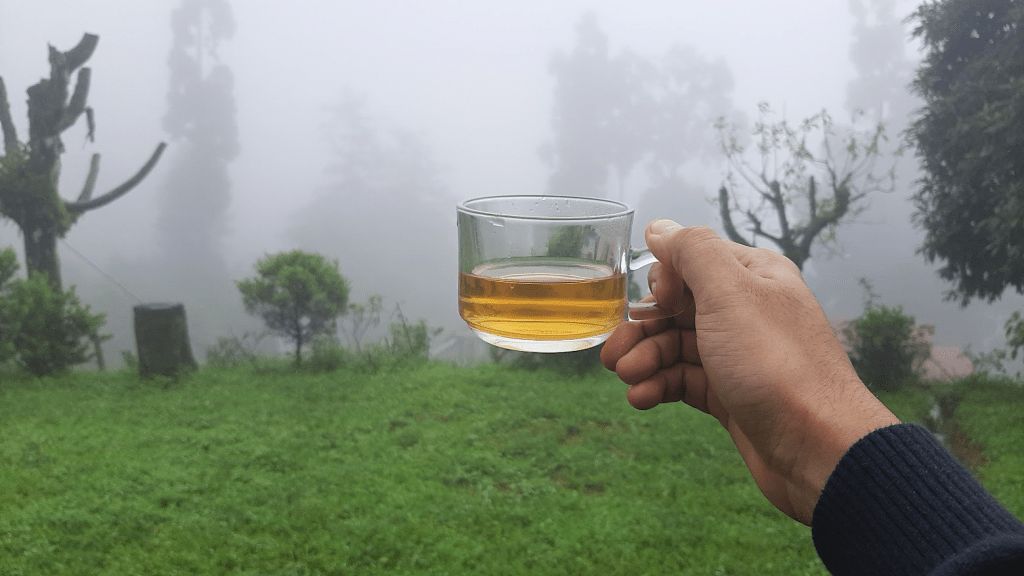
By the time we had settled into the bungalow, the quiet rhythm of Takdah had already begun working its way gently into us.
The place was looked after by Rabindra and his family, and during our stay, we were the only guests there. Perhaps that was why everything felt even more personal and warm. There was no hotel-like formality anywhere. Instead, it felt as though we had arrived at somebody’s old mountain home.
A hearty lunch was soon laid out for us — simple hill food, warm and comforting after the long drive through misty forests. Outside, clouds drifted lazily across the lawn while the pine forest behind the bungalow stood dark and silent under the afternoon sky.
And somewhere between lunch and tea, Satyaki had already found two new friends.
Rabindra’s little daughter and son appeared shyly at first, but children perhaps understand mountains better than adults do. Within minutes, the three of them were running around the verandah, inventing games, laughing over things only they understood, and disappearing into their own tiny world while the hills slowly prepared themselves for evening.
The sun had already begun leaning towards the western sky when we stepped out for a short walk. Long shadows stretched quietly across the empty roads of Takdah, while thin threads of mist started rising once again from the forests below.
What makes Takdah special is not just the village itself, but the feeling of roads leading quietly into different worlds.
One road returns towards Ghum and Darjeeling through the pine forests we had crossed earlier. Another climbs higher into the hills towards Tinchuley, winding through forests and viewpoints. And the third road slowly descends towards the vast Teesta Valley far below.
We chose the third one.
The road descending towards the Teesta Valley began with a softness that only mountain evenings seem to possess.
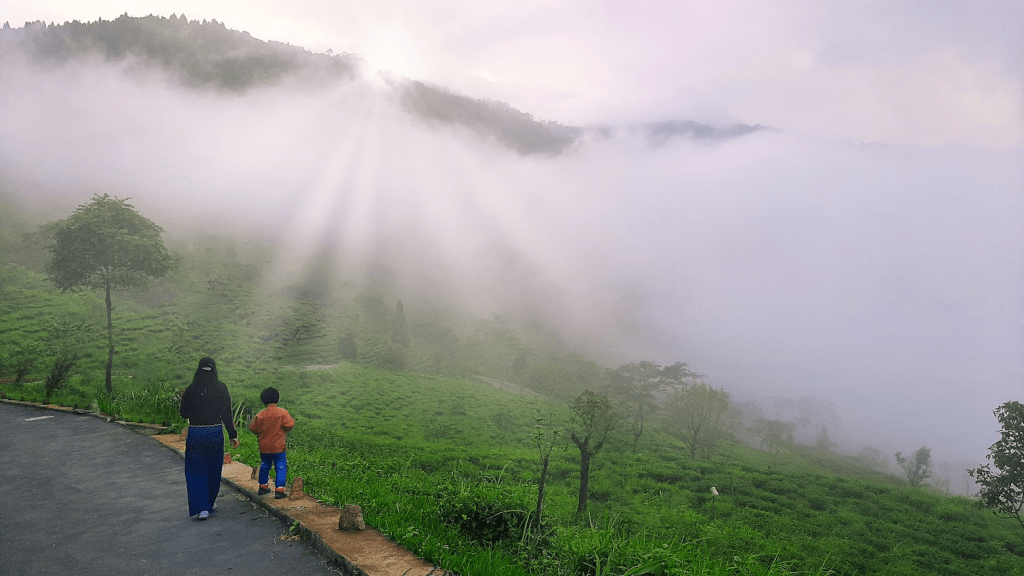
At first, the tea gardens glowed gently under a pale golden sun breaking through layers of drifting clouds. The slopes rolled endlessly across the hillsides, their green leaves shining faintly under the fading light. Far below, waves of mist floated through the valleys while dark pine trees stood quietly like sentinels watching over the mountains. For a brief moment, the entire landscape looked suspended somewhere between sunlight and dream.
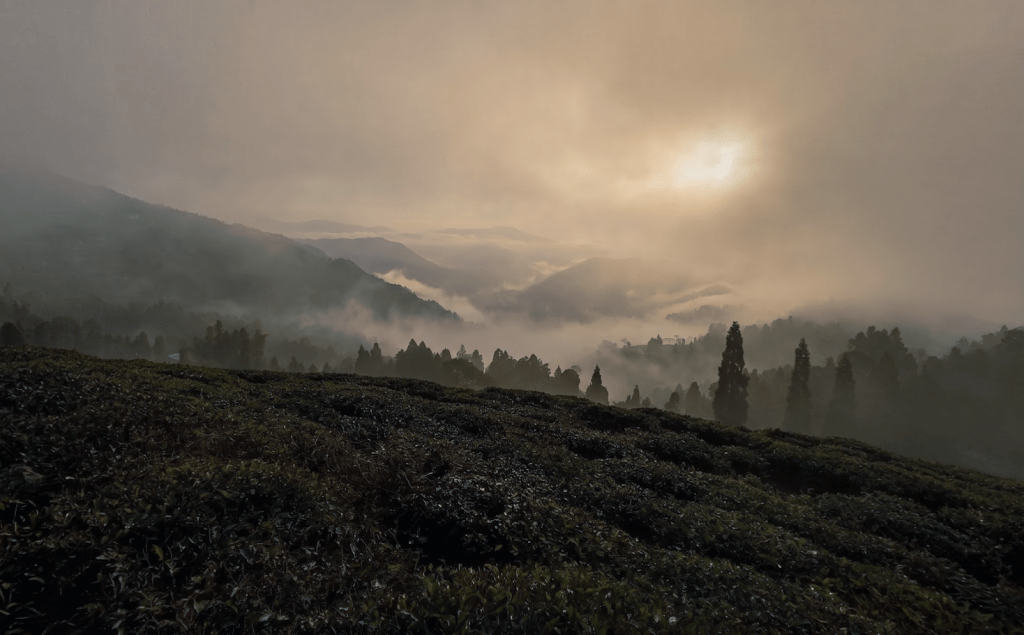
We kept walking slowly down the winding road, stopping every few minutes simply to look around. On one side were tea gardens disappearing down the slopes in delicate curved patterns. On the other side rose damp forest walls covered with ferns, moss and wild mountain plants dripping from the afternoon moisture. The air smelled of wet earth and fresh tea leaves, while the valley below remained wrapped in moving clouds.
Then slowly, almost without warning, the mist began rising.
The distant hills vanished first. Then the tea slopes below disappeared one layer at a time. The soft golden light faded behind thick white clouds until the entire road seemed swallowed by fog. Soon, visibility dropped so much that the road ahead simply dissolved into whiteness.
Figures appeared only as faint silhouettes before vanishing again into the mist. The empty mountain road became strangely silent except for the sound of our footsteps and occasional droplets falling from the trees above. Walking there felt less like a regular evening stroll and more like wandering through a dream slowly erasing itself.
Satyaki, meanwhile, was completely absorbed in his own tiny adventure.
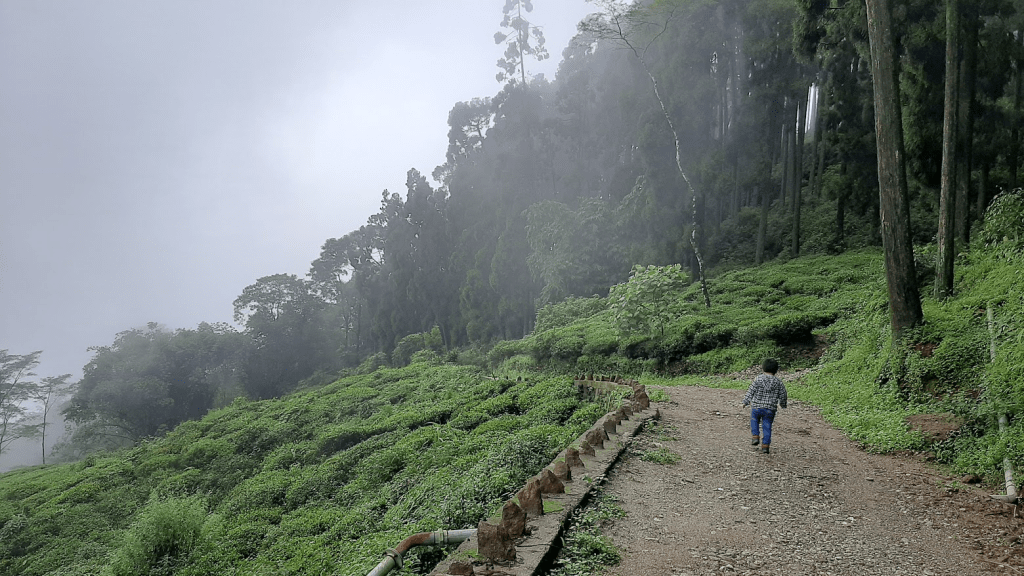
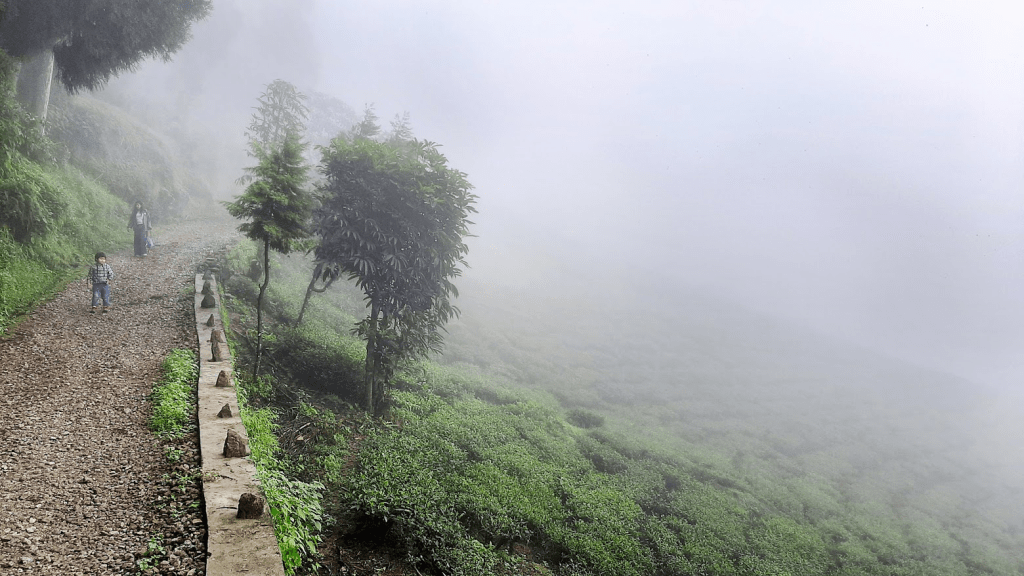
Sometimes he ran ahead fearlessly into the mist-covered road, becoming a small moving shadow against the vast white landscape around him. At other times he stopped beside the tea gardens to inspect leaves, stones or tiny streams flowing beside the road. Children perhaps understand mountains differently — not as destinations, but as places to disappear into for a while.
We paused near a small wooden bench overlooking the tea gardens. Or rather, overlooking where the valley should have been. By then the clouds had covered almost everything below. Manjistha and Satyaki sat quietly beneath a lone tree while waves of mist drifted endlessly across the green slopes around them. Nobody really spoke much. The silence itself felt complete.
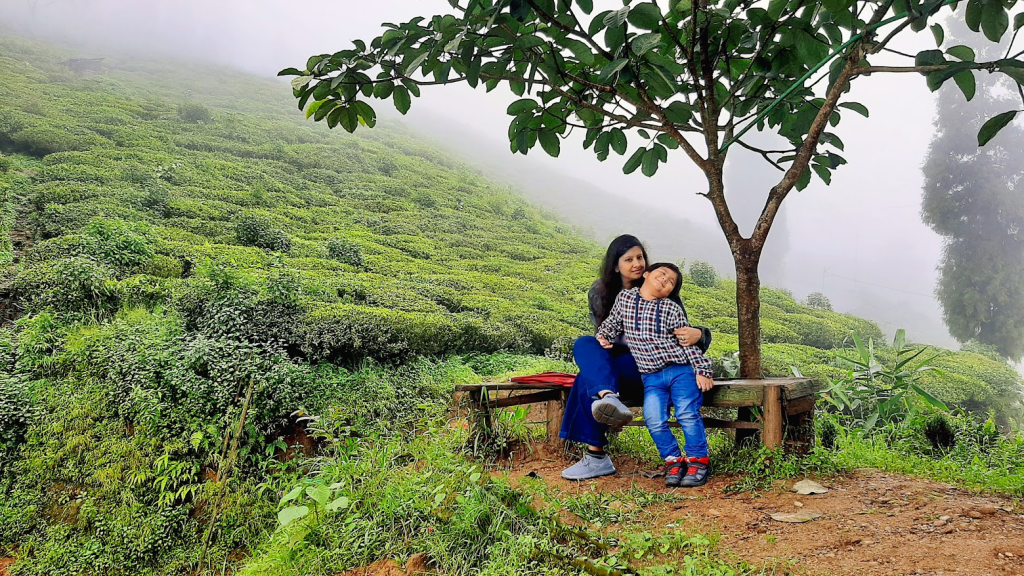
Then came a soft mountain drizzle.
Umbrellas appeared, though the rain was so fine that it seemed to merge naturally with the clouds themselves. Water droplets gathered on pine needles, the narrow road darkened under the moisture, and the smell of rain-soaked earth grew deeper in the cold evening air.
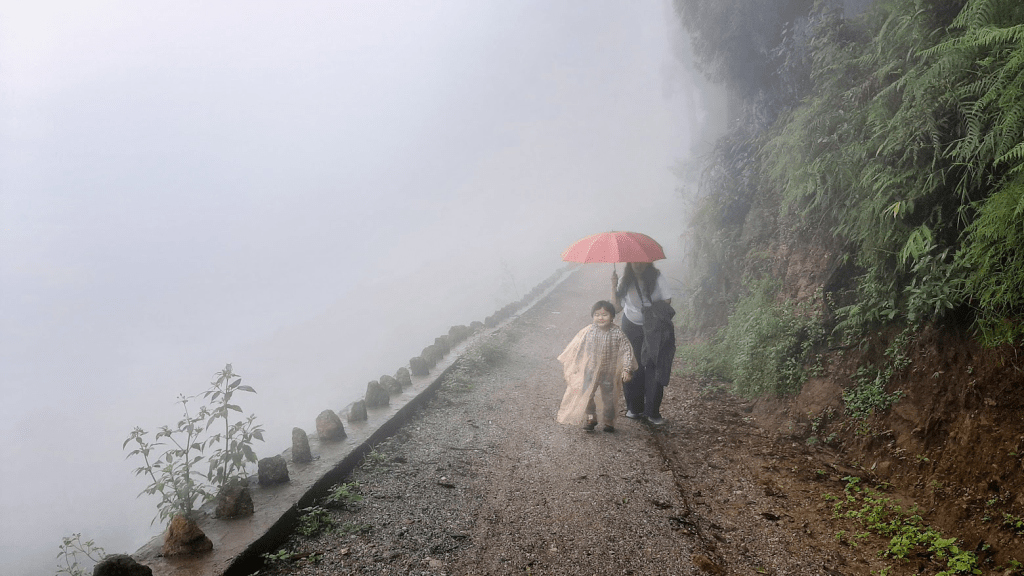
As darkness slowly approached, the forests and tea gardens began fading quietly into shadow. Somewhere below the hidden valley, evening had already settled. And up here in Takdah, among drifting clouds and silent tea slopes, the hills seemed to be preparing gently for night.
Night arrived quietly in Takdah, but the silence of the hills somehow felt deeper after dark.
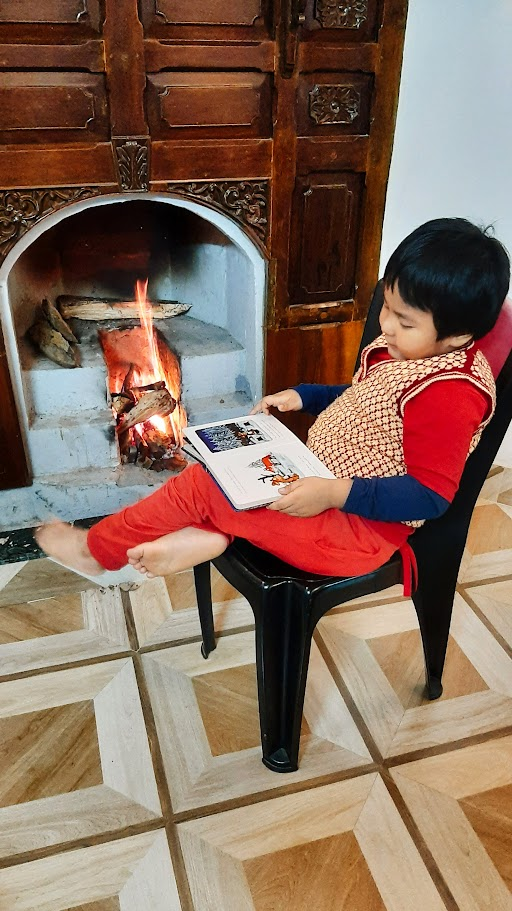
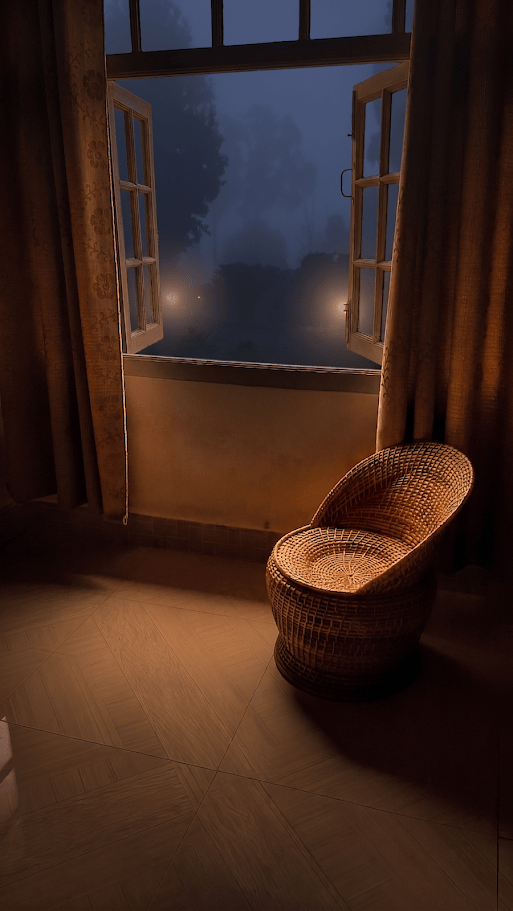
The cold had begun settling heavily over the mountains by then, and soon the old fireplace inside the bungalow was lit up once again after perhaps countless similar evenings across decades. The faint smell of burning wood slowly filled the room while soft orange flames danced against the polished wooden frame surrounding the fireplace. Outside, mist pressed gently against the windows while the forests behind the bungalow disappeared completely into darkness. we sat quietly beside the fire reading books, listening to the occasional crackling of wood and the distant whispers of wind outside. There was no television noise, no traffic, no hurried sense of time moving forward. Only warmth, silence and the strange comfort old mountain houses somehow carry within them.
Rabindra casually mentioned during dinner that only a few days earlier, a dog had been hunted by a leopard barely fifty metres above the bungalow. After that, he advised us gently not to wander outside late at night.
And suddenly the darkness outside began feeling different. Beyond the small patch of light around the bungalow lay deep silent forests. The mist moved slowly through the pine trees while strange mountain insects gathered around the verandah lights, their unfamiliar sounds filling the silence in irregular bursts. Occasionally something rustled faintly somewhere beyond the lawn, though it was impossible to see anything beyond the darkness and drifting fog.
The mountains at night no longer felt merely beautiful. They felt ancient. Yet strangely, that was exactly what made the night in Takdah unforgettable. Sitting beside the old fireplace while cold wind moved silently through the forests outside, it felt as though the hills were allowing us to witness a quieter, older world that still existed beyond the reach of modern noise and certainty.
Morning in Takdah arrived like a gentle reassurance after the mysterious darkness of the previous night. For the first time since we had arrived, the hills had woken up under some sunlight.
The mist was still there but was beginning a slow retreat quietly into the distant valleys, revealing layers of green tea gardens rolling endlessly across the slopes. Sunlight filtered softly through the trees around us, and droplets of last night’s rain still clung to leaves and grass, shining briefly whenever the light touched them.
Everything felt calm. Comforting.
The forests that had seemed deep and unknowable in the darkness now stood peaceful under the morning sky. Smoke rose lazily from distant village homes hidden among the hills, birds called continuously from the trees, and somewhere nearby, the smell of fresh tea and wood smoke drifted through the cold mountain air.
Standing outside the bungalow with warm cups of tea in hand, watching sunlight slowly spread across the valleys, it became difficult to imagine rushing anywhere at all.
The morning in Takdah never fully settled into either sunshine or mist. Instead, the two seemed to play an endless game of hide and seek across the hills. One moment the valleys below glowed softly under sunlight breaking through the clouds, and the next moment everything disappeared again beneath drifting white fog. Long beams of light occasionally pierced through the mist and spread across the tea gardens like something almost unreal. The hills kept revealing and hiding themselves quietly, as though the mountains were allowing us only brief glimpses of their world.
We decided to spend the morning slowly wandering towards Tinchuley.
The road climbed gently through tea gardens and forests, sometimes opening towards vast valleys below and sometimes disappearing completely into pine woods soaked in mist. There was no urgency anywhere. Takdah seemed to encourage only one kind of travel — slow travel.
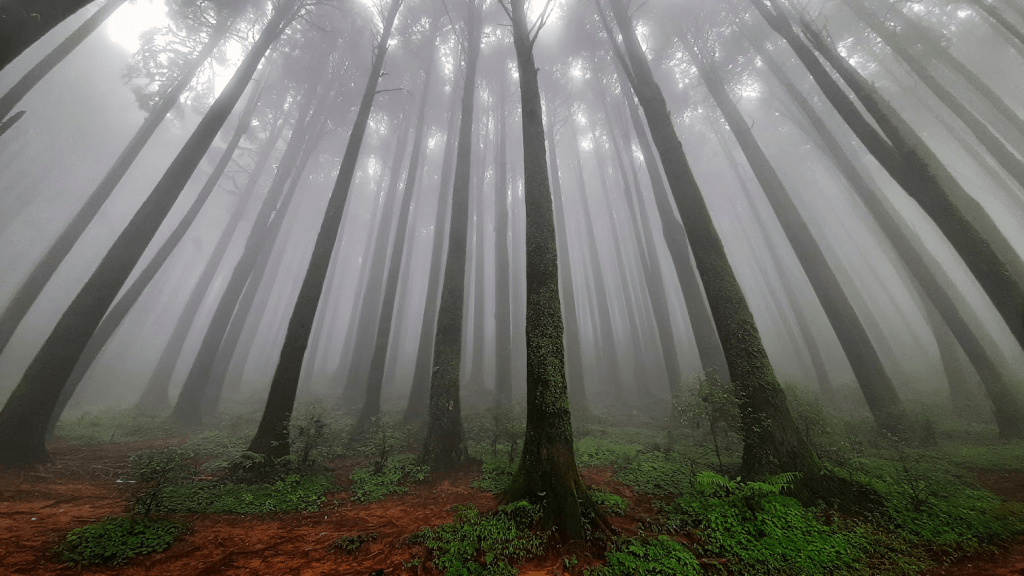
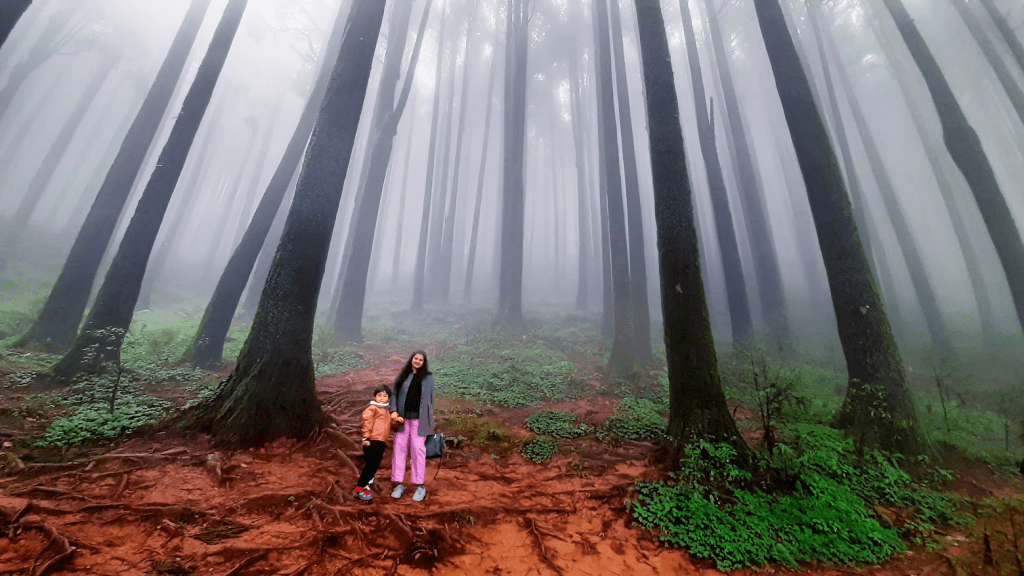
At one point, a narrow forest trail disappeared among towering pine trees, and naturally we followed it. The forest there felt ancient and strangely cathedral-like. Tall straight trunks rose endlessly upwards into white mist, their tops completely hidden beyond the clouds. The ground beneath was covered with damp pine needles, exposed roots and soft mountain moss glowing deep green under filtered light.
It was impossibly quiet.
Only the occasional sound of water droplets falling from branches disturbed the silence. The mist kept moving slowly through the forest floor, wrapping itself around the tree trunks before dissolving again. Standing there beneath those enormous pines, it almost felt as if time itself had slowed down inside the forest.
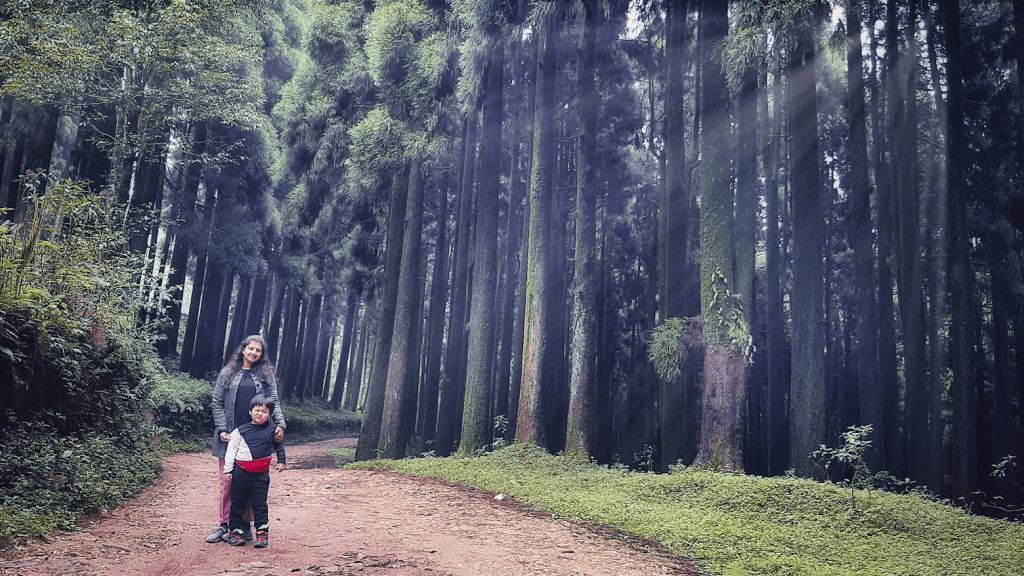
Further along the road towards Tinchuley, the clouds suddenly began thinning for a few moments.
Far away behind layers of floating mist, faint outlines of the great mountains slowly emerged for a brief while — distant snow-covered peaks appearing like ghosts behind the clouds before hiding themselves once again. It was only a partial glimpse, almost teasing in nature, yet enough to make everyone stop silently beside the road.
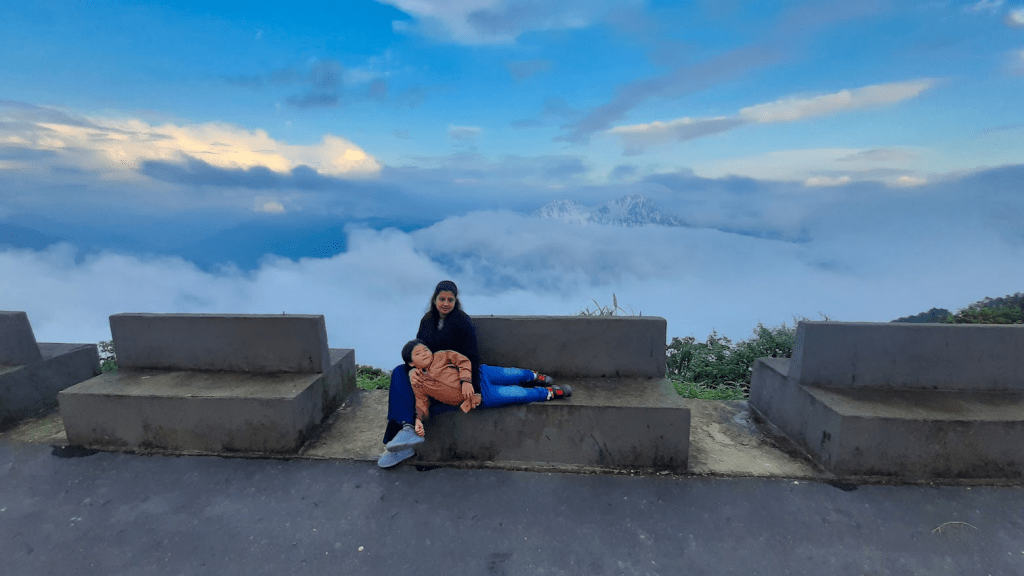
Nothing in Takdah revealed itself completely. The mountains appeared only in fragments. The valleys emerged slowly through clouds. Sunlight lasted for only a few minutes before mist reclaimed the hills once more.
And somehow, that constant incompleteness made the entire landscape feel even more magical.
But we not ready for awaited us in the night
But Takdah was perhaps still holding back its most unforgettable moment for us.
The rest of the afternoon passed lazily under drifting mist and intermittent rain. Clouds wandered slowly across while cold mountain winds moved gently through the pine forests. Everything felt quiet, beautiful and almost dreamlike in that familiar Takdah way.
Yet somewhere beneath that calmness, the hills seemed to be preparing for something else.
Darkness arrived early in the valleys below, swallowing the valley and roads one by one. After dinner, Rabindra suggested a short drive through the Takdah forests nearby. He suggested that it would be an experience – and what an experience it was.
The forest looked completely different after dark. Our headlights cut through dense mountain fog while towering pine trees emerged silently from the darkness before disappearing again behind us. The road twisted endlessly through the forest with no signs of human life anywhere around. Occasionally the mist became so thick that the light itself seemed unable to travel far ahead.
Inside the car, conversations had become quieter by then.
Perhaps it was the forest. Or perhaps it was the strange feeling that the mountains at night were awake in ways we could not fully understand.
Then suddenly, something appeared on the road ahead.
A porcupine.
For a few seconds it simply walked in front of our car, unhurried and strangely calm, its dark silhouette moving through the mist while the headlights illuminated its sharp quills faintly from behind. The little creature continued trotting ahead as though guiding us deeper into the forest.
And then it happened.
Without warning, a dark four-legged shape crossed the road ahead of us in one swift silent movement.
Not a dog. Not cattle. Something far more fluid and powerful.
The headlights caught only fragments of it for barely for 2 or 3 seconds — a dark muscular body melting across the mist-covered road before vanishing instantly into the forest on the other side.
A black panther.
It was Manjistha who first let out a short startled gasp. And then for a few seconds, nobody inside the car spoke at all.
The entire scene felt almost unreal in that moment — the pitch dark forest, the towering black pine forests standing silently around us, strange night sounds echoing faintly from somewhere deep inside the hills, and that dark majestic animal crossing the lonely mountain road with effortless silence before disappearing once again into the wilderness.
It did not feel like spotting wildlife. It felt like the forest revealing itself for a brief second.
It was Satyaki who broke the silence. Somehow, that his voice made everyone breathe normally again.
Rabindra slowed the vehicle instinctively, still staring towards the darkness where the animal had vanished. He quietly reminded us again about the sightings from the previous month. But by then, the atmosphere inside the car had already changed. The forests outside no longer felt merely scenic or mysterious. They suddenly felt alive in a far older and wilder way.
And strangely, everything about Takdah until then now seemed connected somehow — the drifting mist, the silent forests behind the bungalow, the warnings about leopards near the hills, the eerie stillness after dark.
Perhaps the mountains had been preparing us for that moment all along.
The strange encounter from the previous night stayed quietly with us even the next morning.
As we stepped outside the bungalow, the forests no longer felt merely scenic. Somewhere beneath those silent pine-covered slopes, hidden behind drifting mist and endless valleys, the wilderness of Takdah continued breathing quietly on its own terms. Perhaps because of that, the hills appeared even more beautiful the following morning. Unlike the mist-heavy moods of the previous days, the morning had opened under bright sunlight.
Breakfast was quick, and by 9′ o clock we were descending towards teesta.
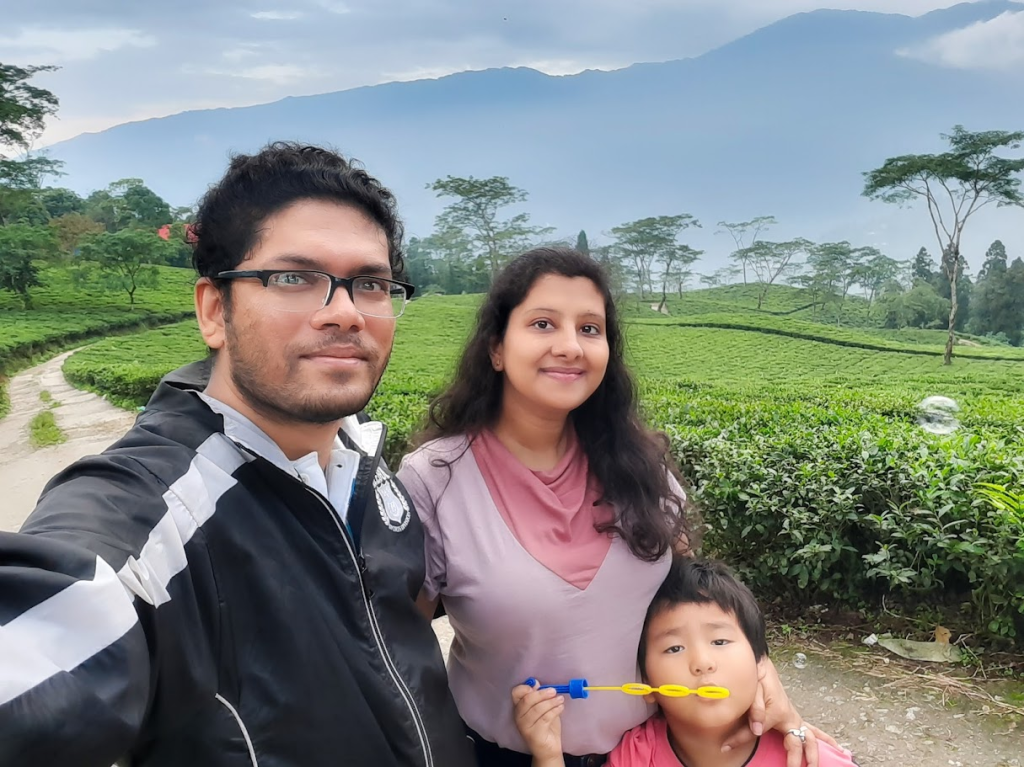
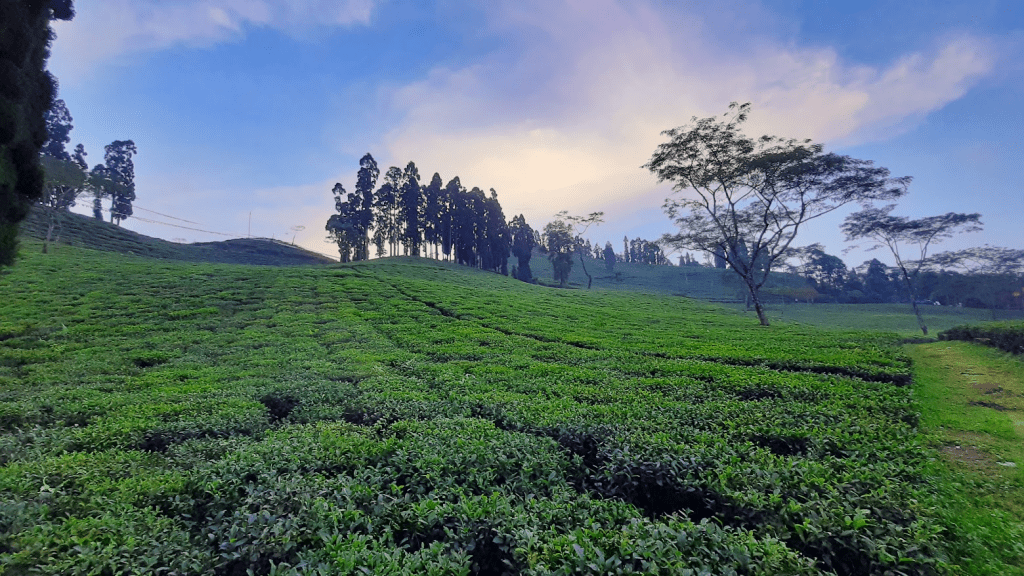
The tea gardens glowed vividly across the hillsides, their endless green curves flowing over the mountains like soft waves frozen in time. White clouds drifted lazily through distant valleys while sunlight moved slowly across the slopes, changing shades of green every few minutes. The roads winding through the gardens looked almost painted against the landscape.
We drove first towards the rolling tea estates of Rangli Rangliot.
The name itself carries a beautiful old meaning — “thus far and no further.” Standing there among those endless tea slopes overlooking deep valleys and distant mountains, the phrase somehow felt strangely appropriate.
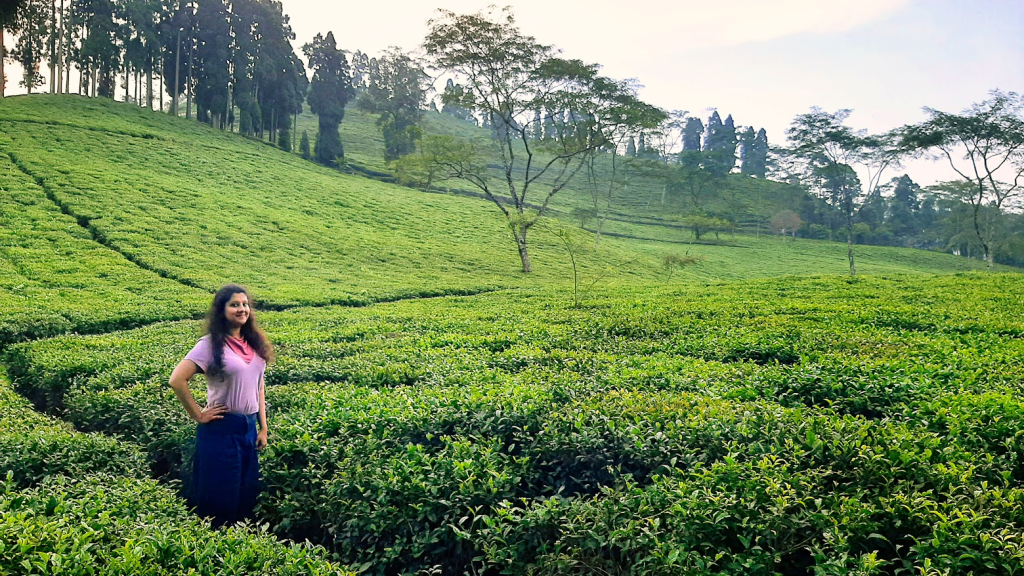
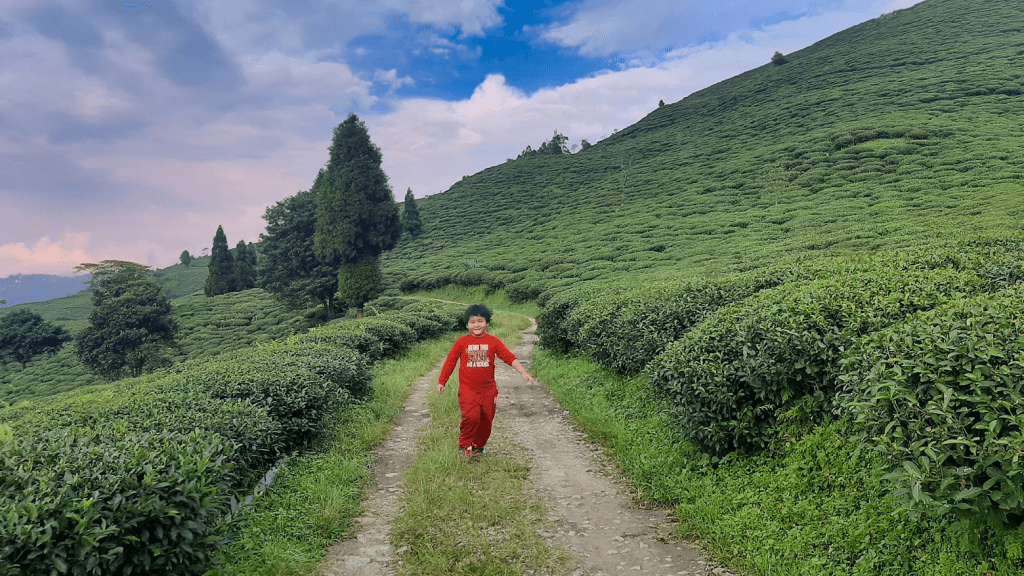
Satyaki ran happily along the narrow garden paths while we wandered without hurry through the estates, stopping every few minutes simply to absorb the view. Takdah was not the kind of place that demanded sightseeing checklists. It invited something much rarer — lingering.
From Rangli Rangliot, the road first descended gently through folds of green hills before slowly climbing again towards the beautiful stretches of the Teesta Valley Tea Estate.
The drive itself felt unhurried and cinematic.
Roads curved quietly through endless tea slopes while clouds drifted lazily across distant valleys below. Roads curved quietly through endless tea slopes while clouds drifted lazily across distant valleys below. Every few bends revealed another layer of green hills rolling endlessly into the horizon.
Eventually, the road came to a quiet halt beside one of the most beautiful stretches of the estate.
Before us lay wave after wave of tea gardens flowing gently over the hillsides, their perfectly trimmed bushes covering the mountains in endless textures of green. The late afternoon light had softened beautifully by then, casting a calm golden glow across the slopes while delicate clouds drifted slowly over the distant valleys.
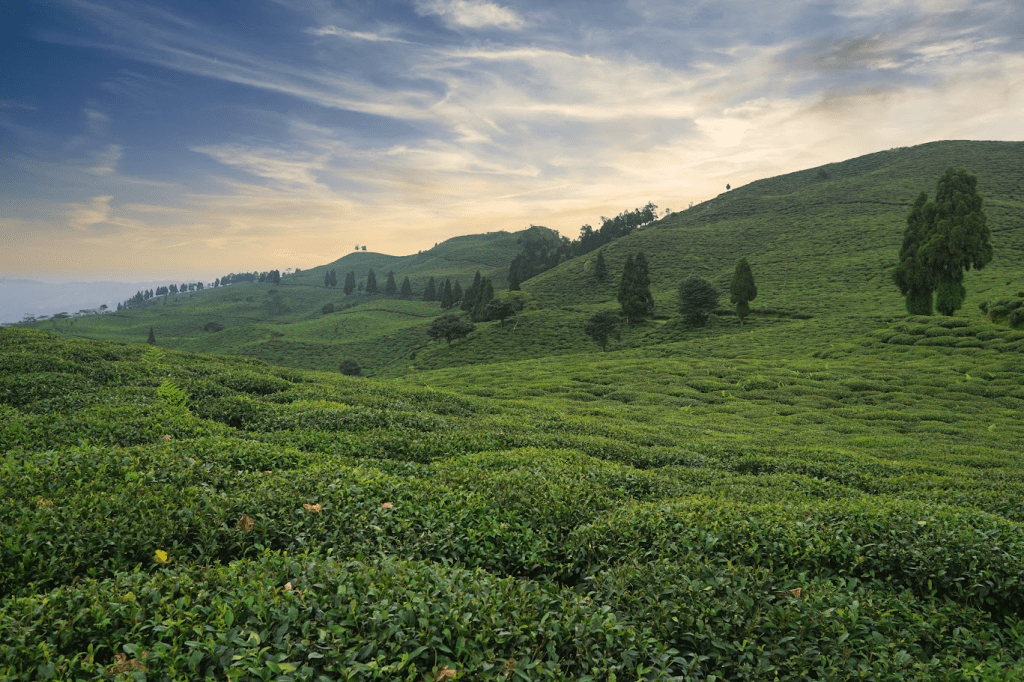
And then we noticed a small narrow trail disappearing quietly through the tea gardens. Naturally, we began walking.
The little track wound gently between the tea bushes, sometimes disappearing behind soft green ridges before emerging once again further ahead. Around us, the hills remained almost impossibly quiet except for occasional mountain winds brushing softly across the leaves.
There was something deeply peaceful about walking there.
After a quick change of clothes for Satyaki, whose adventures through mist, mud and tea bushes had already left visible marks everywhere, we began descending towards the Teesta River.
The road wound steadily downward through changing landscapes. The soft tea-covered hills of Takdah slowly gave way to deeper valleys, denser forests and warmer mountain air. Yet even during the descent, the tea gardens continued appearing in magnificent stretches across the slopes — endless rolling carpets of green under shifting mountain light.
At places, the estates looked almost surreal.
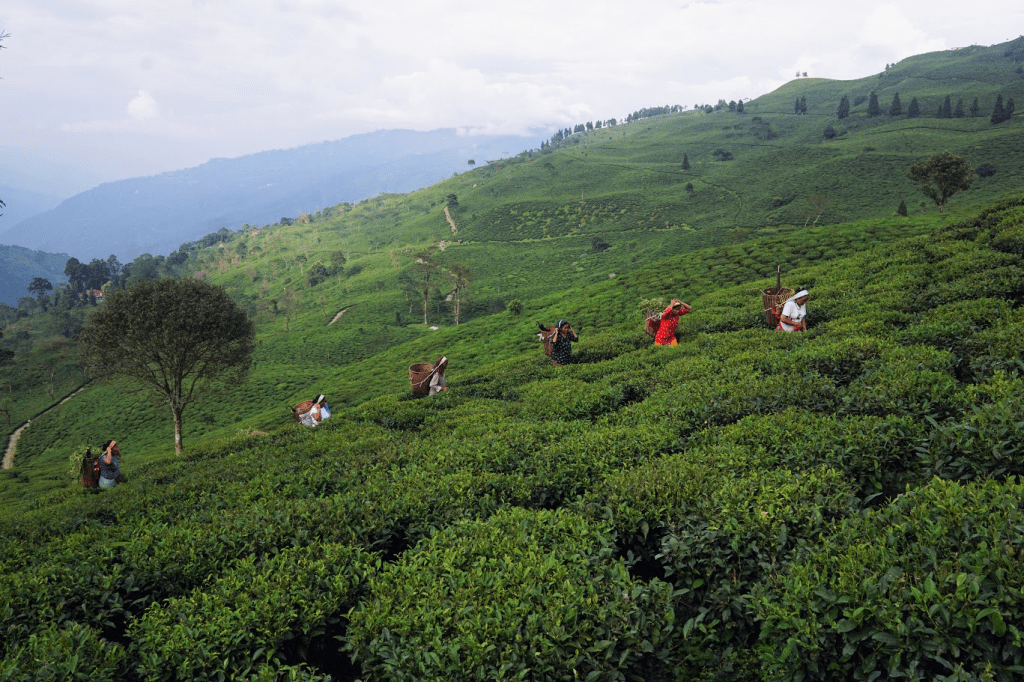
Tea bushes flowed over entire hillsides in graceful patterns while lone trees stood scattered across the landscape like brushstrokes on a giant green canvas. Women carrying woven baskets moved quietly through the gardens, plucking leaves with practiced rhythm while distant mountain ridges faded softly into blue haze beyond them.
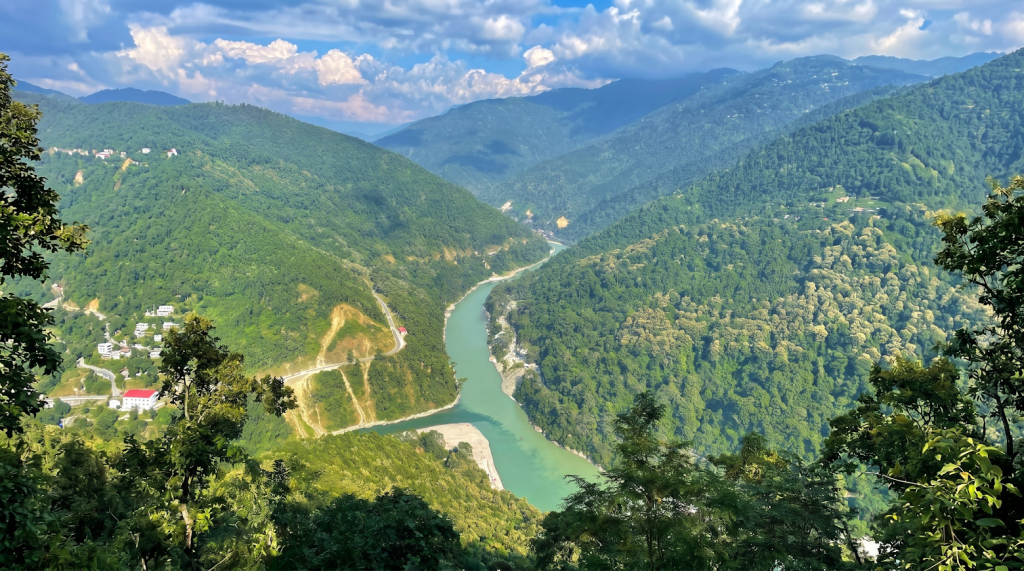
The farther we descended, the larger the valleys began feeling. And then eventually, the mountains opened up dramatically before us at the viewpoint overlooking the confluence of the Teesta River and Rangeet River.
From above, the rivers looked magnificent.
The pale green waters curved powerfully through deep forested valleys surrounded by towering mountains on all sides. Roads clung precariously to the hillsides far below while clouds drifted slowly over the distant ridges under a vast Himalayan sky. Standing there, one could truly understand how enormous and ancient these mountain valleys really are.
But simply seeing the rivers from above somehow did not feel enough.
So we continued descending further until we finally reached the riverbanks themselves.
Down there, beside the flowing waters, the scale of the mountains felt even more overwhelming. The rivers moved endlessly between dark forested slopes while the afternoon sunlight reflected softly on the water. Satyaki immediately became absorbed in his own small world beside the shore — poking wet sand with a stick, watching the currents and wandering barefoot along the edge of the river.
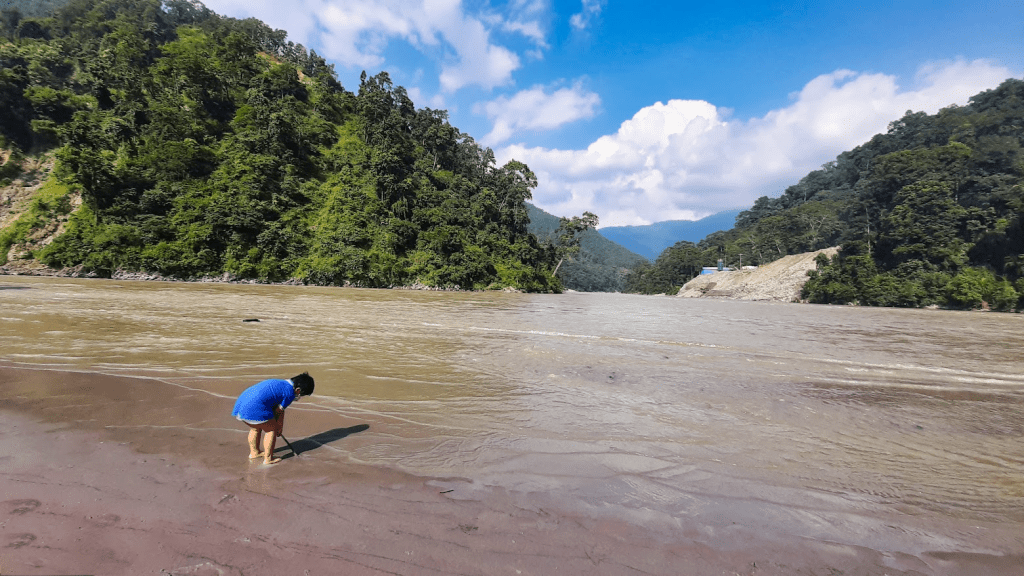
Meanwhile the mountains remained around us in complete silence, as though everything from the misty tea gardens of Takdah to the roaring rivers below belonged to one vast connected landscape slowly unfolding layer by layer.
By the time we began climbing back towards Takdah, evening had already started settling softly over the mountains once again.
The roads grew quieter with every turn. The warm river valleys slowly disappeared behind us while colder winds returned through the forests higher up. Tea gardens reappeared gradually along the slopes, fading in and out beneath drifting mist. Somewhere far away, hidden behind layers of hills and clouds, the last traces of sunlight lingered briefly before dissolving into grey evening silence.
When the familiar pine forests near Takdah finally appeared again, it strangely felt less like returning to a destination and more like returning to a state of mind.
The bungalow lights glowed faintly through the mist as we arrived back. Somewhere inside, dinner was already being prepared. The forests behind the house had once again turned dark and unreadable. And yet, after everything the hills had shown us over the last few days — the silent tea gardens, the drifting clouds, the hidden mountains, the strange wilderness of the night forests — the silence no longer felt empty.
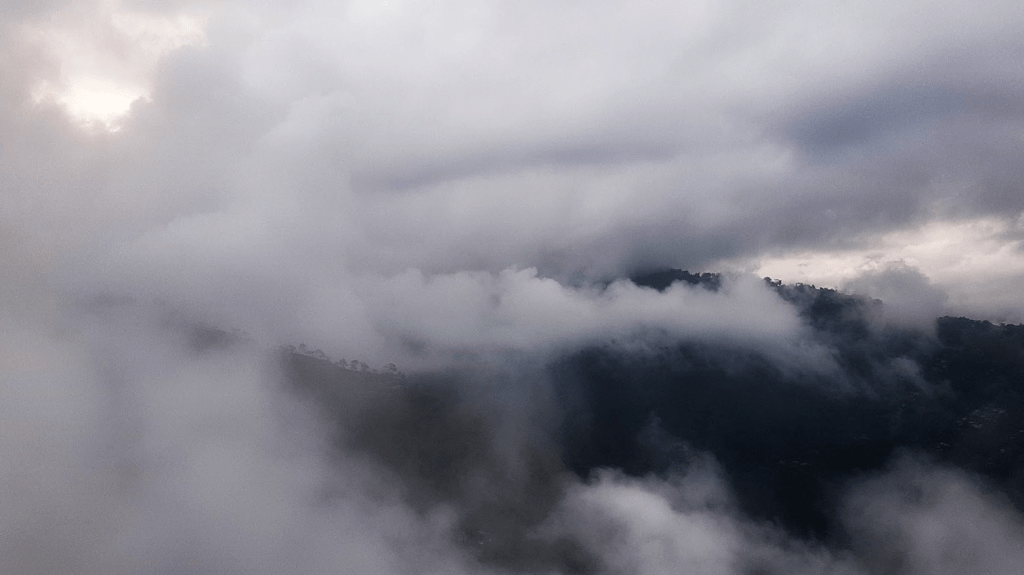
Late that night, after everyone had gone to sleep, I stepped out quietly into the verandah for a while.
The hills had disappeared completely into darkness again. Only the faint sound of wind moved through the pine trees somewhere below. A few insects circled lazily around the yellow verandah light. From far away in the valley came the distant murmur of a river moving through the mountains in the dark.
I remember thinking then that places like Takdah never really end when the journey ends. They remain somewhere inside you afterwards — like an unfinished dream, or perhaps like a song whose last few notes continue floating silently in the air long after the music has stopped.
And even today, whenever I think of Takdah, I do not remember it as a place first. I remember the feeling of mist moving quietly through pine forests while somewhere unseen in the darkness, the mountains continued breathing on their own and the black panther roams.
 Mustard Feet's Journeys
Leave a comment